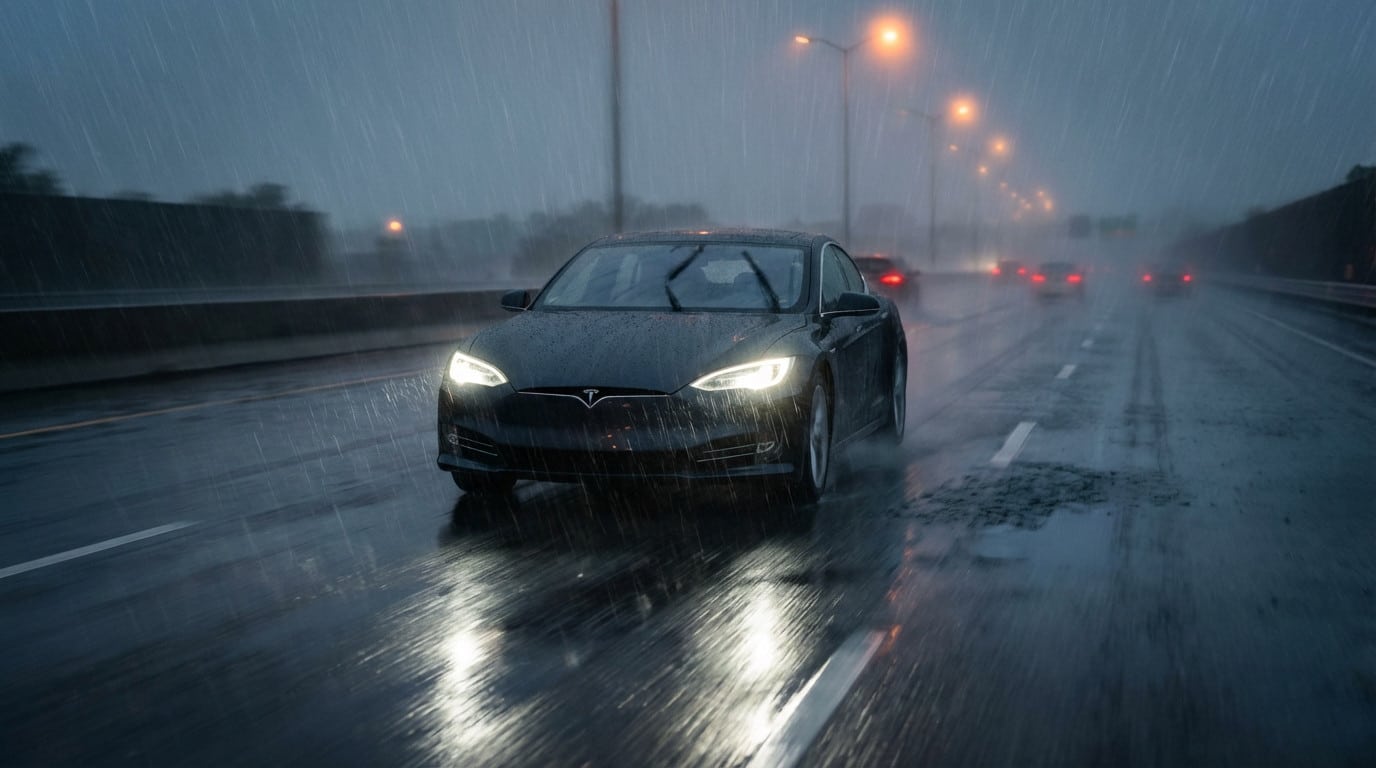
We naturally assume our modern vehicles serve as infallible safety cocoons, yet the disturbing reality of adas bad weather performance suggests a dangerous betrayal of that trust during common rainstorms. A rigorous evaluation by the AAA exposes how standard features like automatic braking and lane keeping frequently malfunction when confronted with precipitation, often failing to warn the driver of their inactivity. We analyze these alarming failure rates to reveal exactly why your car’s sensors go blind and how you must adapt your driving before technology leads you into a preventable collision.
The Stark Numbers: AAA’s Damning Verdict on ADAS in the Rain
Automatic Braking Failures: A Shocking Risk of Collision
We often treat Automatic Emergency Braking (AEB) as an infallible safety net, but the reality is far less comforting. The AAA study rips that bandage off, exposing how fragile this technology becomes when the skies open up.
The raw data is difficult to digest. Even at a school-zone speed of 25 mph (40 km/h), 17% of tests resulted in a collision. That implies that nearly one in five times, the car slammed into the obstacle it was explicitly programmed to avoid.
These weren’t freak storms, either. The tests utilized simulated rain on the windshield, a standard scenario any driver faces.
Lane Keeping Assist: Dangerously Lost in the Storm
If you thought braking performance was shaky, the results for Lane Keeping Assist are downright terrifying. The cameras simply cannot cope.
Here is the statistic that should make you grip the wheel tighter: in a staggering 69% of cases, the vehicles drifted right over the lane markers. That is a failure rate of more than two out of three.
The implication is a severe risk of running off-road or into oncoming traffic. The tech meant to secure you becomes an active hazard in bad weather, leaving you drifting while you think you are safe.
The Speed Factor: How Faster Driving Amplifies Failure
It stands to reason that speed complicates things, yet the AAA study quantifies this danger with brutal precision.
Revisiting the AEB tests paints a grim picture. The collision rate jumped from 17% at 25 mph to a massive 33% at only 35 mph (56 km/h). A minor increase in velocity nearly doubled the failure rate.
The lesson is clear: as your speedometer climbs in the rain, your ADAS reliability plummets, leaving you exposed.
No Warning Signs: The Silent Failure of Safety Systems
Perhaps the most chilling detail from the study involves the system’s communication. During most failures, the car issued no warning or alert whatsoever.
The driver assumes the system is active, while it is actually blind. This silence breeds a false confidence that is perhaps the biggest collision risk, leaving humans relaxed when they should be hyper-alert to the road conditions.
Behind the Curtain: Why Your Car’s Senses Fail
The Camera’s Blurry World: When Rain Is Like a Blindfold
Most ADAS configurations rely heavily on a mix of sensors to function effectively. But let’s be real, the optical camera is the absolute workhorse for identifying exactly what is sitting in front of your bumper.
Here is the snag: a camera needs to see, just like you do. Throw in heavy rain, fog, or snow, and that ““vision” gets compromised fast. Suddenly, crisp lane markings vanish and other cars turn into blurry, indistinct blobs.
The AAA study points the finger right at this optical failure for why AEB systems crash so often during simulated rain.
Radar’s Blind Spot: Seeing Cars But Not Lines
Then you have the radar, the camera’s partner in crime. Its massive advantage is that it punches right through bad weather, barely flinching when the skies open up.
But radar has a major blind spot: it is blunt. Sure, it knows something is there and how far away it is, but it cannot interpret lane markings or read the road’s nuance.
This explains why Lane Keeping Assist fails so hard in the rain—the camera is blind, and the radar is useless for that specific task.
A Flawed Partnership: When Sensor Fusion Isn’t Enough
Engineers talk about “sensor fusion”—combining the camera’s sharp eye with the radar’s range to cover for each other. On paper, it sounds like the perfect safety net.
However, the AAA findings prove this strategy has serious holes. When the camera—essential for seeing lines—is knocked out by rain, the radar cannot magically step in to paint the picture.
So, the whole system becomes only as strong as its weakest sensor in that moment. Severe ADAS bad weather performance degradation isn’t just a risk; it is practically guaranteed.
The Problem With a Dirty View
Interestingly, the study also threw bugs and dirt at the windshields to test resilience. In those specific tests, the systems held up surprisingly well, showing only minor hiccups.
But don’t get complacent. The AAA’s takeaway is pure common sense: if a dirty windshield messes with your vision, you better believe it is blocking your car’s camera too.
| Sensor Type | Primary Function | Strengths | Key Weakness in Bad Weather |
|---|---|---|---|
| Camera | Object classification, lane detection | Identifies shapes and colors | Heavily impaired by rain, fog, snow, low light |
| Radar | Distance and speed measurement | Works well in most weather, sees far | Cannot detect lane markings or read signs |
A Pattern of Problems: More Than Just a Rainy-Day Issue
While the failures in rain are alarming, that’s just the tip of the iceberg. Previous AAA research has already highlighted a pattern of weaknesses that questions the overall reliability of these systems.
The Challenge of Curves and Moderate Traffic
We often focus on adas bad weather performance, but the issues run much deeper. Even with perfect visibility, these systems struggle in daily driving situations. You simply cannot set it and forget it.
AAA research shows lane-keeping tech often fails to track winding roads correctly. They behave unpredictably when traffic gets moderate. In fact, active assistance drops significantly on sharp curves. You simply cannot trust them to steer for you without constant supervision.
Failing to See the Most Vulnerable: Pedestrians at Night
Previous studies reveal a critical blind spot regarding pedestrian detection. This is especially true at night. Low light severely handicaps the cameras, leaving them practically blind to people walking. It’s a scary reality we must face.
This highlights a fundamental flaw in the current technology. Systems perform worse exactly when human life is most at risk. This drastically increases the risk of collisions with the most fragile road users on our streets.
The Stationary Vehicle Paradox
We also see a major failure with cars stopped in the lane. Many AEB systems fail to detect a vehicle already at a standstill. The sensors simply don’t register the obstacle in time to stop.
It’s a disturbing paradox. The system is built to stop crashes. Yet, it can be completely baffled by a common highway accident scenario. We expect better protection than that from modern tech, but the data says otherwise.
A Checklist of Known ADAS Limitations
To sum it up, the list of weaknesses for Advanced Driver Assistance Systems is longer than most drivers realize.
Common Scenarios Where ADAS Can Falter:
- Adverse weather conditions (rain, snow, fog) significantly reduce sensor performance.
- Difficulty tracking lane markings on curvy roads or when markings are faded.
- Poor detection of pedestrians and cyclists, especially at night.
- Inconsistent reaction to stationary vehicles or obstacles in the lane.
Testing in a Bubble: The Industry’s Disconnect From Reality
Facing this pile of evidence, we have to ask how technology with such glaring flaws ends up in millions of driveways. A big part of the answer lies in the way they are tested.
The “Sunny and Dry” Myth of Safety Standards
Current protocols from giants like ISO, SAE, and NHTSA feel surprisingly detached. They set the bar, yet that bar seems stuck in a laboratory vacuum. We trust these benchmarks blindly.
Most validation happens in a dream world. The tracks are bone-dry, the sky is perfectly clear, and lane markings look freshly painted. That is a sanitized utopia no average driver ever visits.
This sterile approach paints a dangerously optimistic picture of actual adas bad weather performance. It sells a capability that dissolves when reality hits.
What Current Tests Are Missing
The AAA study doesn’t just find faults; it exposes a gaping hole in validation procedures. We are missing the messy stuff.
Real-World Conditions Ignored by Standard Tests:
- Varying intensities of precipitation like moderate to heavy rain or snow often go unchecked.
- Scenarios with low light, glare, or fog that challenge cameras are frequently skipped.
- Roads with worn-out lane markings or complex intersections are rarely simulated.
- Interactions with other vehicles driving erratically or unpredictably are missing from the script.
A Call for Real-World Scenarios
The AAA and safety experts are demanding a total overhaul of these standards. We need systems evaluated exactly where drivers struggle the most. Testing must mimic the chaos of a real commute, not a clean lab.
Ironically, we test robustness in conditions where we barely need assistance. The priority should be guaranteeing reliability when the situation gets complicated. After all, a safety net is useless if it vanishes when you fall.
Why This Gap Puts Drivers at an Unspoken Risk
This disconnect between lab tests and asphalt reality is not just a technical footnote. It carries immediate, physical consequences for everyone on the road. Safety cannot be theoretical.
This gap breeds dangerous overconfidence, often fueled by slick manufacturer marketing strategies. We buy these cars believing they protect us everywhere, regardless of the elements. But that shield is conditional and fragile. It often shatters precisely during adverse weather, leaving us exposed when we are most vulnerable.
Your Brain is the Ultimate Upgrade: Reclaiming Control from the Machine
ADAS is an Assistant, Not the Pilot
Let’s be clear about the AAA’s findings regarding these technologies. These setups are strictly “driving aids,” never “autopilots.” The word “assistance” in the name is the only clue you need. They are built to support you, not to take over.
They exist to back up an attentive and engaged human, not to replace your eyes. Thinking otherwise is a mistake that drives the recent surge in specific accidents mortels. You cannot afford to check out mentally.
The Irreplaceable Value of Human Judgment
The AAA uses a powerful phrase: the human brain is still the “best onboard computer.” It is a sharp way to summarize the reality of the road. No sensor suite matches your biological processor when the rain starts falling.
A human interprets context, anticipates abnormal situations, and makes decisions based on years of experience. A machine, right now, simply applies an algorithm based on often imperfect data. It lacks the instinct that keeps you safe on wet tarmac.
Practical Steps for Driving with ADAS in Bad Weather
To counter poor `adas bad weather performance`, you must apply these specific safety recommendations to stay safe.
Your Safety Checklist for Driving in Rain:
- Slow down significantly. Speed is a major factor in ADAS failure.
- Increase your following distance to 5-6 seconds, not the usual 2-3, to compensate for sensor lag.
- Do not use cruise control (standard or adaptive). You need full control when traction is low.
- Ensure your windshield and wipers are in perfect condition for maximum visibility.
Understanding Your Vehicle’s Specific Limits
I strongly advise you to ignore the glossy marketing brochures today. The only document that actually counts is the vehicle owner’s manual in your glovebox. It holds the real truth about your car’s capabilities and its hard failures.
It is the only place that honestly explains the system’s limits, when to use it, and when NOT to use it. Reading it carefully is not just an option; it is an absolute necessity for your survival.
Looking Ahead: The Difficult Road to All-Weather ADAS
Is LiDAR the Answer? A Look at the Next Wave of Sensors
The vehicles in the AAA study relied on cameras and radar, lacking LiDAR technology entirely. That’s a significant omission because many experts see light detection as the next big leap. It fills the gaps where optical cameras struggle. Basically, it’s the missing piece of the puzzle.
LiDAR shoots laser pulses to build a precise 3D map, cutting through conditions that blind standard lenses. It offers depth perception that flat images just can’t match. The Lucid Air is already pioneering this tech on US roads.
The Software Challenge: Better Algorithms and Sensor Fusion
But let’s be real, throwing better hardware at the problem isn’t a magic fix. The sensors are useless without a brain to interpret the noise. That’s where the software comes in. It’s the invisible driver making the split-second calls.
The real breakthrough will come from smarter AI algorithms that master “sensor fusion.” They need to stitch together radar, camera, and LiDAR inputs seamlessly. If one sensor fails due to adas bad weather performance, the others must pick up the slack immediately.
The Long-Term Vision vs. Today’s Reality
We keep hearing about a future where cars drive themselves while we nap. Yet, today’s tech can barely handle a moderate rainstorm without panicking. There is a massive gap between the marketing hype and what happens on wet asphalt. It’s jarring.
Before we hand over the wheel completely, manufacturers need to get the basics right. You can’t skip steps on the ladder to autonomy. Making current assistance systems bulletproof in a simple drizzle is non-negotiable. Safety isn’t a beta test.
Surviving the Elements: A Universal Tech Challenge
This struggle against Mother Nature isn’t unique to driver assistance systems. Every piece of outdoor tech fights a losing battle against the elements. Rain, grime, and cold don’t care about sophisticated engineering. It’s a universal headache for engineers everywhere.
Just look at the hurdles facing the integration of solar panels on cars. Trying to make delicate photovoltaics survive weather extremes and road debris is a nightmare. It proves that durability is just as hard to crack as intelligence.
Ultimately, the AAA’s findings serve as a stark reminder that technology, however advanced, remains fallible. While ADAS offers valuable support, it cannot replace human intuition. We must remain vigilant, treating these systems as assistants rather than replacements, ensuring safety even when the skies open up.