Do you feel the rising frustration as us city traffic congestion returns to suffocate our daily commutes with renewed intensity? We analyze the latest data to understand why gridlock has surprisingly surged past pre-pandemic levels despite the flexibility of hybrid work. Discover the staggering economic costs and the counterintuitive reasons why simply building more lanes fails to solve this escalating urban crisis.
The Gridlock Is Back and Worse Than Ever
America’s Most Congested Cities in 2025
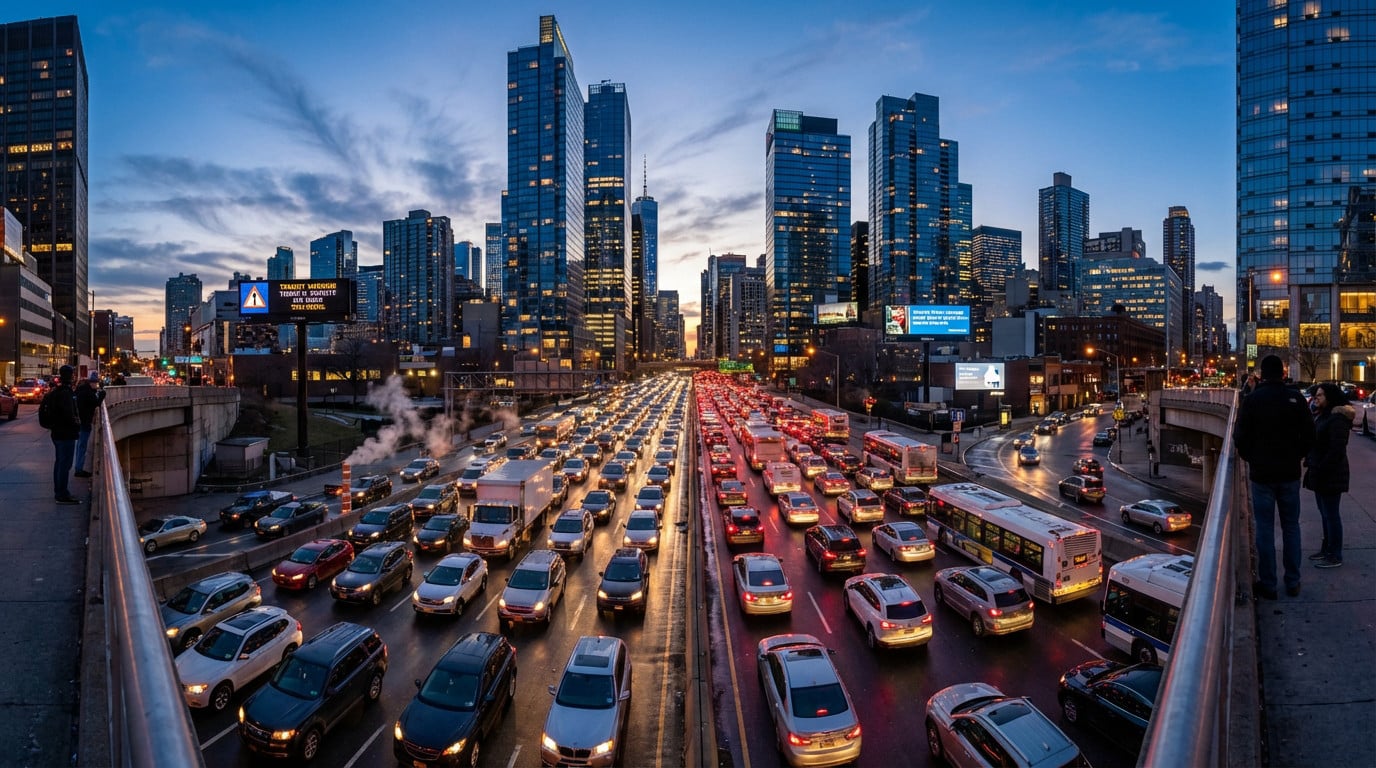
Traffic has not only returned to its pre-pandemic baseline; it has aggressively surpassed those levels in many major metropolitan areas.
The 2025 INRIX report delivers a harsh reality check regarding us city traffic congestion. Chicago has officially dethroned New York to become the undisputed leader in gridlock, with drivers now sacrificing 112 hours annually on the asphalt.
| Rank | City | Hours Lost per Driver (2025) | Change from 2024 |
|---|---|---|---|
| 1 | Chicago | 112 hours | +12 hours |
| 2 | New York City | 105 hours | +9 hours |
| 3 | Philadelphia | 98 hours | +10 hours |
| 4 | Boston | 95 hours | +8 hours |
| 5 | Washington D.C. | 92 hours | +15 hours |
The Real Cost of Sitting in Traffic
These lost hours represent a direct economic hemorrhage. Fuel is wasted while engines idle, costing the average Chicago driver over $2,000 annually in lost productivity.
Beyond the financial drain, our quality of life is eroding under the weight of increased stress and pollution.
This density places immense pressure on urban infrastructure and compromises safety, sparking renewed debates akin to the invention of jaywalking as a crime.
Why the Quiet Streets Didn’t Last
The Illusion of Empty Roads
Remember those open highways in 2020? That silence was a total fluke, temporarily masking the brutal reality of us city traffic congestion. We foolishly tricked ourselves into thinking the gridlock was gone for good.
Then came the mandates. The aggressive return to office, even on hybrid schedules, has choked our infrastructure all over again. Just look at Washington D.C., where federal policies snapped the trap shut on daily commuters.
A booming economy puts more wheels on the pavement. It is simply, and unfortunately, an affliction of abundance.
Building More Roads Is Not the Answer
Urban planners call this phenomenon “latent demand”. You widen a highway to fix the jam, but that fresh asphalt just invites more drivers to jump behind the wheel. Within months, those expensive new lanes are clogged.
The real issue is that we give away road space for free. Experts argue that congestion pricing remains the only mechanism that actually clears the streets. If you don’t charge for the space, people will waste it.
Cities Face a New Kind of Traffic Jam
Peak Hours Are Blurring
We often assume the rush hour is back to its old self, but the reality is quite different. Hybrid work schedules have flattened those traditional 8 a.m. and 5 p.m. spikes we used to dread. Instead, we are seeing a surge in mid-day volume that catches drivers completely off guard.
It is not just commuters clogging the arteries, either; the streets are fighting a new battle.
- Exploding demand for urban deliveries—from Amazon packages to lunch orders—floods the streets.
- Freight trucks frequently stop mid-lane, forcing cars to bottle up.
- Data from Seattle shows this congestion is now smeared across the entire day.
The Difficult Search for Solutions
Most municipalities are scrambling because the old playbooks simply don’t work against this evolving us city traffic congestion. While scooters and bikes offer a glimmer of hope, micromobility has not yet scaled enough to make a real dent in the gridlock.
This complexity turns local governance into a high-stakes game. Every position opening on City Council is now a referendum on how to fix our streets. Real relief likely demands a mix of bold policy and tech, like the integration of solar power in vehicles.
The resurgence of severe congestion signals that our approach to urban mobility demands a fundamental shift. We cannot simply build our way out of this gridlock. Embracing bold policies and adaptive technologies remains our best hope for navigating a future where our streets effectively serve people, not just stalling traffic.