With the automotive industry currently torn between ambitious electric promises and practical daily realities, identifying the true market leaders has become increasingly difficult for observers. This report on the world’s best selling cars cuts through the speculation to present the definitive 2025 sales data, marking the pivotal moment the Toyota RAV4 reclaimed its global supremacy from the Tesla Model Y. We analyze the strategic shift toward hybrid technology that fueled this reversal and explore how enduring icons like the Corolla and F-Series sustain their massive popularity in a rapidly changing landscape.
The Current Global Sales Leaderboard
A New King for 2025: The Hybrid Comeback
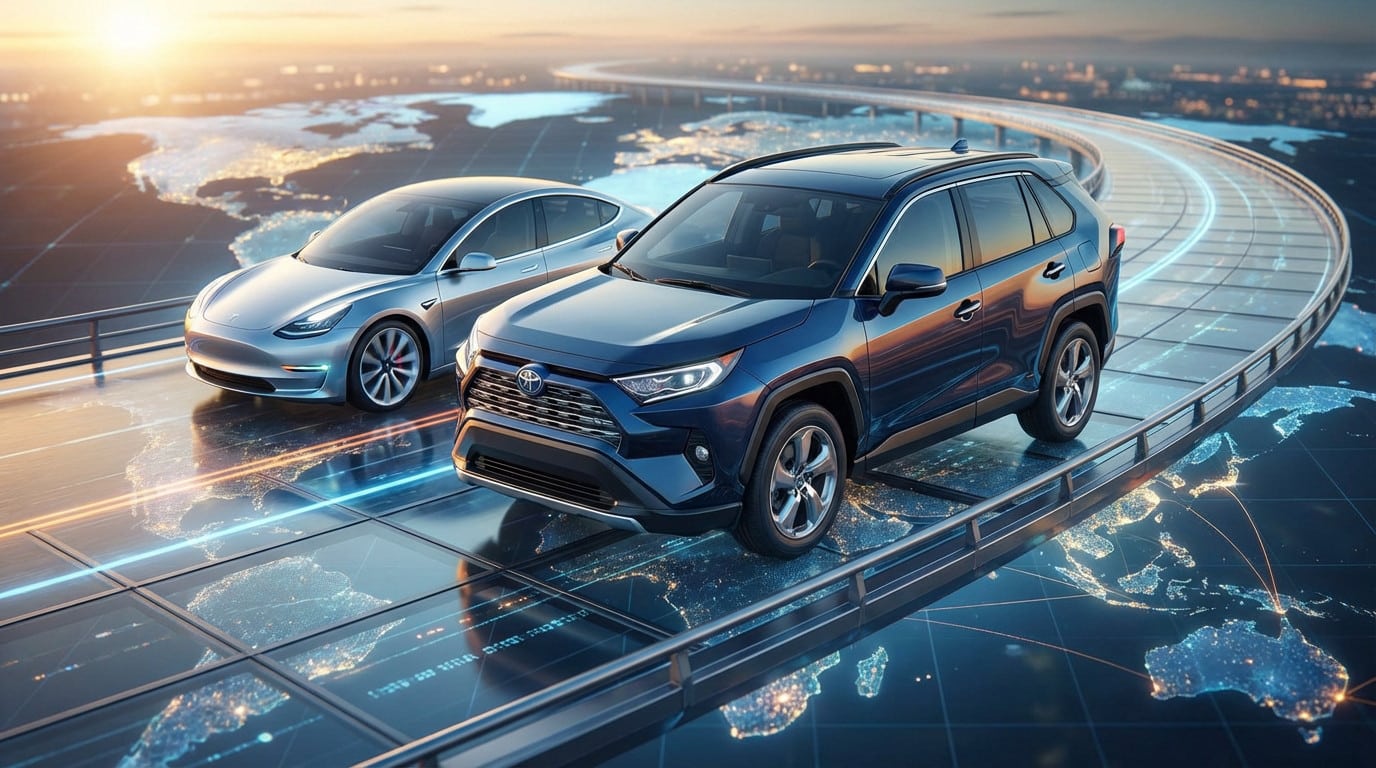
The Toyota RAV4 has officially reclaimed the throne as the world’s best-selling vehicle in 2025, according to provisional data. It successfully dethroned last year’s leader, the Tesla Model Y. This marks a major shift in the hierarchy.
This resurgence is largely driven by the massive appeal of its hybrid powertrain. The model racked up an impressive 2.1 million units sold globally. Meanwhile, the broader market saw standard hybrids surge by 20%, proving efficiency still rules.
Clearly, the battle for the top spot is far from settled. Consumer preferences are shifting faster than manufacturers can adapt.
The Top 5 Global Contenders Right Now
Here is a snapshot of the current power dynamic. These figures perfectly illustrate where the world’s best selling cars stand today.
| Rank | Model | 2025 Provisional Sales | YoY Change | Key Driver |
|---|---|---|---|---|
| 1 | Toyota RAV4 | 2.1 million | +1.5% | Hybrid efficiency |
| 2 | Toyota Corolla | 1.9 million | Stable | Reliability & affordability |
| 3 | Tesla Model Y | 1.8 million | -11.2% | EV market leader |
| 4 | Ford F-Series | 1.6 million | +2% | North American dominance |
| 5 | Honda CR-V | 1.4 million | +3% | Comfort & space |
You can see the remarkable stability of the Toyota Corolla, holding its ground. Conversely, the Tesla Model Y shows a slight dip after its meteoric rise. It seems the initial EV hype is cooling off.
The Ford F-Series and Honda CR-V remain immovable pillars. They simply refuse to give up their market share.
Tesla’s Historic, but Short-lived, Reign
The Tesla Model Y undeniably wrote history back in 2023. It became the first 100% electric vehicle to top the annual global sales charts. That moment signaled a massive shift for the industry. It was a wake-up call for everyone.
This dominance was fueled by explosive demand across Europe, China, and North America. In Q1 2023 alone, it moved 267,200 units, sealing its victory over the Corolla. It seemed unstoppable at the time.
Even if it slipped, the Model Y proved EVs can fight at the top level. It represents a milestone for the EV industry. We likely haven’t seen the last of it.
The Forces Shaping Our Driving Choices
We have seen who dominates the leaderboard, but it is time to understand why. The numbers only tell part of the story; the real reasons hide in the deep-seated trends guiding buyers across the globe.
The Unstoppable Rise of the SUV
Look at the top five, and you see a clear pattern: the chart is almost entirely dominated by SUVs and pick-ups. The RAV4, the crossover Model Y, the F-Series, and the CR-V prove this overwhelming preference. Sedans are barely holding on.
Drivers aren’t just buying cars; they are prioritizing polyvalence, space, and a high driving position above all else. Models like the Hyundai Tucson and Mazda CX-5 might sit lower in the top 10, but they are surfing this exact same wave. It is about feeling safer on the road.
Consequently, traditional berlines are losing ground fast. Just look at the Volkswagen Golf’s retreat in the rankings; it simply cannot compete with this massive shift.
Hybrids: The Pragmatic Choice in a Shifting Market
The RAV4 taking the crown isn’t a fluke. It signals a massive comeback for hybrid vehicles, offering a safety net that many drivers crave right now. It is the pragmatic middle ground.
Here is why they are climbing the world’s best selling cars list:
- Reduced fuel consumption without range anxiety.
- Lower upfront cost compared to many pure EVs.
- No need for home charging infrastructure.
With shaky charging grids and battery prices staying high, hybrids feel like a smooth, economical transition. This is the winning strategy for Toyota, and you can see it paying off handsomely with the Corolla too.
The Electric Vehicle Reality Check
The Tesla Model Y dropping 11.2% might look bad, but don’t call it a failure yet. It is a necessary market adjustment after years of explosive growth. The hype is simply settling down.
Competition is getting fierce, especially with Chinese giants like BYD entering the ring. Plus, government subsidies are drying up in key regions, which directly impacts the final price. Buyers are looking at the tag and thinking twice.
The electric shift is definitely real, make no mistake. But the market is stabilizing and becoming brutally competitive, explaining this slight dip.
The North American Fortress: How Pickups Skew the Global Charts
But global trends get overshadowed by massive regional phenomena. To really grasp the ranking, we must detour to North America, where one vehicle type rules alone.
Ford F-Series: More Than a Truck, an Institution
The Ford F-Series, particularly the F-150, has ruled US sales for decades. Its high standing among the world’s best selling cars relies almost entirely on this massive market. It is a purely local king.
You spot them in Canada and Mexico, yet they remain ghosts elsewhere. Their high unit value makes them a financial fortress for Ford. Drivers show intense brand loyalty here. This generates massive profits annually.
Count every version since 1948, and it might sit as history’s second best-seller. That sheer volume is simply staggering.
Chevrolet Silverado: The Eternal Rival
The Chevrolet Silverado stands as the F-Series’ shadow and primary foe. It ranks consistently right behind Ford on American roads. This truck anchors General Motors’ dominance in the region. The competition is relentless.
This Detroit clash creates a total duopoly on full-size trucks. Their combined sales force is undeniable. That is why two pickups crash the global top 10. It skews the worldwide perspective completely.
Why the World Doesn’t Drive Pickups
Outside North America, these giants are simply unfit. High fuel costs and tight taxes kill their appeal in Europe and Asia. Narrow roads make them impossible.
The practical need for such beasts is strictly North American. This proves regional markets distort global figures. We see a skewed reality.
Driving these monsters is tricky, even requiring the best GPS applications for heavy trucks to navigate efficiently. It is a different world.
The Silent Achievers: Models Built on Trust and Value
You can’t discuss the world’s best selling cars without bowing to the master. The Toyota Corolla isn’t just a vehicle; it is the absolute sales king of all time.
We are talking about numbers that make your head spin: over 50 million units since 1966. It built this empire on bulletproof reliability, an affordable price tag, and keeping running costs incredibly low.
It remains a massive hit across Europe, Asia, and Australia. In fact, more than 50 million units sold proves it transcends fleeting trends.
Toyota Corolla: The Undisputed Champion of All Time
But the Corolla doesn’t stand alone. Other heavyweights share this exact philosophy of prioritizing function over flash.
- Honda CR-V: Loved for comfort, space, and fuel economy in Asia and the USA.
- Nissan Sentra: A key player in Latin America and Asia, representing Nissan’s compact push.
- Hyundai Tucson: Gaining ground with sharp tech, safety features, and a competitive price.
These models might not grab headlines, but they form the backbone of the global market. They answer the call for drivers who simply need something reliable and practical for the daily grind.
The Fading Giant: What Happened to the Volkswagen Golf?
Then there is the Volkswagen Golf. Once the undisputed ruler of Europe and the second best-selling car in history, things have shifted dramatically.
It is sliding down the ranks, battered by the fierce SUV craze and the electric shift. Even within VW, new hybrids and electrics are cannibalizing its sales.
Its story is a stark warning: the market changes fast, sparing no icon.
What the Bestsellers List Tells Us About the Future
The Brand Battle: Toyota’s Quiet Dominance
Look at the numbers. Toyota parks two of its models, the RAV4 and the Corolla, right at the top of the global podium. It is a brutal demonstration of industrial strength.
This validates their controversial dual strategy. They combine pragmatic hybrids with legendary reliability to capture a massive slice of the pie. You see, they simply cover more of the actual market.
While competitors chase headlines with flashy prototypes, Toyota quietly shifts millions of units. That is why they remain the undisputed sales king.
The Long Road to Full Electrification
Here is the reality check on the EV revolution. The RAV4’s 2025 victory over the Tesla Model Y proves the transition to all-electric isn’t a straight line.
Buyers are voting with their wallets on price, range, and charging infrastructure. These are non-negotiable hurdles. Manufacturers ignoring these friction points do so at their own immediate immediate peril.
The immediate future looks like a messy mix of powertrains. Plug-in hybrids are clearly not dead yet.
The Underlying Message: Practicality Still Wins
Look at the top ten list closely. Whether it is a Ford F-Series or a compact SUV, the winners all solve a specific problem. They offer space, economy, or pure work capacity. It is about utility first.
Flashy tech grabs attention, but raw utility drives volume. Practicality is the secret sauce. It transforms a decent car into one of the world’s best selling cars.
Automakers must remember this rule. In fact, keeping a car running reliably for years often comes down to simple maintenance, like knowing how to clean car fuel injectors at home.
The 2025 rankings offer us a clear lesson: while technology advances, practicality remains king. The Toyota RAV4’s hybrid triumph over the Tesla Model Y signals a market seeking balance between innovation and reliability. As preferences evolve, the most successful vehicles are those that truly understand and serve our daily driving needs.