Have you ever watched a project fall apart simply because the chosen bond failed to withstand the specific demands of its environment? Mastering the distinct chemical and physical properties inherent to different types of adhesive tapes turns every temporary fix into a durable solution for both delicate crafts and rugged industrial tasks. We analyze fourteen specialized variants to ensure you select the exact material required to secure your work with absolute confidence.
The Household Workhorses: Tapes for Daily Fixes
Duct Tape: The Go-To for Quick Repairs
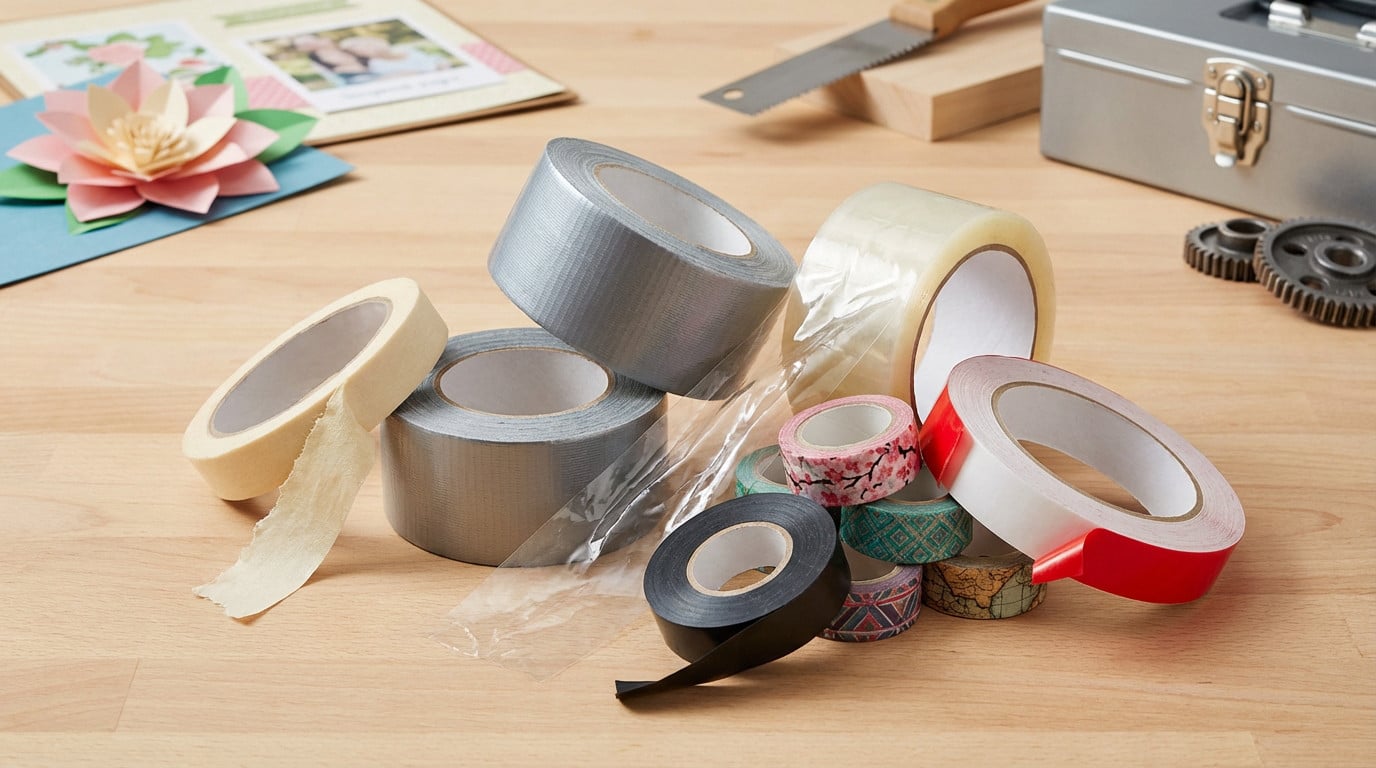
Duct tape is arguably the most versatile of all types of adhesive tapes you can buy today. It features a flexible fabric backing coated with a powerful rubber-based adhesive. This construction makes it incredibly robust for heavy-duty tasks. It grips irregular surfaces with surprising ease.
We use it to seal, repair, and bind almost anything. You might patch a leaking pipe temporarily or bundle loose cables together. It handles these rough jobs without failing immediately.
However, it earns its reputation for temporary outdoor repairs rather than permanent ones. Prolonged exposure leaves nasty sticky residues that are a pain to clean.
Packing Tape: Securing Your Shipments
Packing Tape is the absolute standard for shipping goods securely. Manufacturers design it specifically to seal cartons for transit. You simply cannot ship a package safely without it.
Its pressure-sensitive adhesive bonds instantly to corrugated cardboard surfaces. The material is strong and naturally resistant to moisture against rain or dampness. You will mostly see it in clear or brown variations.
Reliability here is the key factor so your parcel arrives intact. A weak seal means lost goods, which nobody wants to deal with.
Masking Tape: For Clean Lines and Easy Removal
Masking Tape acts as the best friend for painters and DIY enthusiasts. Its primary job involves creating sharp, clean paint lines on walls. The adhesive allows for easy removal without damaging the underlying surface. It peels off smoothly every time.
We strictly use it for short-term applications on smooth, dry areas. Manufacturers offer it in various widths to suit different project scales. You shouldn’t leave it on for too long.
The “painter’s tape” variant offers better resistance to paint bleed. It makes sure your finish looks professionally done.
Electrical Tape: Safely Insulating Wires
Electrical Tape is a non-negotiable safety tool for any wiring work. Crafted from stretchy vinyl, its main function is to isolate exposed wires and cables. This prevents dangerous short circuits in your electrical systems. It embraces the wire tightly.
It stays resistant to moisture, abrasion, UV rays, and heat. The flexibility allows it to wrap perfectly around awkward wire shapes. It protects against harsh environmental damage effectively.
The different colors serve a purpose beyond aesthetics. We use them to code and identify specific circuits quickly.
Specialized Tapes for Construction and Tough Jobs
While standard adhesives handle light work, some projects demand materials that can withstand structural stress or environmental hazards.
Drywall Tape: The Backbone of Smooth Walls
Consider drywall tape the unsung hero of interior construction. Its primary role involves reinforcing the joints between plaster panels to create a single, unified surface. Without it, your walls would look like a grid of disconnected sheets.
This tape helps prevent cracks that inevitably appear as a building settles over time. You typically choose between a paper version that requires bedding or a self-adhesive fiberglass mesh that speeds up the application process.
Ultimately, it is the key to obtaining smooth wall finishes, a step you cannot skip before installing new types of windows.
Filament Tape: When You Need Serious Tensile Strength
When packing tape fails, filament tape steps in for the most demanding bundling tasks. Manufacturers construct this material by embedding it with fiberglass filaments, giving it a distinct, ribbed texture you can feel.
This structure provides incredibly high tensile strength. It is exactly what you need for bundling heavy metal pipes or reinforcing shipping boxes that are carrying significant weight across the country.
In fact, filament strapping tape marries this brute force with exceptional grip, making it superior to standard options for securing heavy loads.
Teflon Tape: The Plumber’s Secret Weapon
Open any professional toolkit, and you will find Teflon tape, often called plumber’s tape or PTFE. Unlike the others, this is a non-adhesive ribbon designed for a very specific, high-stakes purpose.
Its sole function is sealing pipe threads to stop water or gas from escaping your fittings. It acts as both a lubricant for a tighter fit and a reliable sealant.
Given its resistance to heat and chemicals, it remains indispensable for leak-proof connections in everything from showers to gas lines.
Foam Tape: Sealing Gaps and Reducing Vibrations
Foam tape offers a versatile solution when you need to fill a void rather than just stick things together. Its compressible nature allows it to mold perfectly into uneven surfaces, effectively sealing gaps that flat tapes simply cannot touch.
We use it constantly for insulating drafty windows, reducing vibrations in rattling machinery, or mounting objects on textured walls. It serves as a buffer as much as an adhesive.
It features a powerful adhesive backing and can often resist outdoor conditions, making it a go-to for automotive fixes or marine applications.
Tapes for Safety and Extreme Environments
Some tapes do not just stick; they protect. Let’s examine those designed for safety, visibility, or to withstand conditions that would destroy ordinary adhesives.
Reflective Tape: Increasing Visibility in the Dark
Reflective tape isn’t just a sticker; it is a passive safety device. Its primary job is straightforward: reflect light directly back to the source, making objects pop in the dark.
This capability is vital for improving visibility in low-light conditions. You will often see it marking hazardous zones, outlining trailers on the highway, or attached to bicycles and work clothing for safety.
Beyond visibility, it boasts impressive durability, weather resistance, and adheres aggressively to almost any exterior surface.
Anti-slip Tape: Preventing Falls on Slick Surfaces
Next, we have anti-slip tape, frequently known in the trade as “grip tape.” Its sole purpose is to generate traction exactly where it is missing to keep people upright.
The surface feels rough, much like sandpaper, providing enhanced grip. This texture creates the friction needed to prevent dangerous slips and falls on smooth or wet flooring.
Common uses include stairs and ramps, securing grip in high-stakes environments from factory floors to motorsport paddocks.
Glass Cloth and Friction Tapes: For Heat and Grip
Finally, consider two specialized contenders. Glass cloth tape is flame retardant and withstands extreme temperatures. You will find it used in heavy industry or on printed circuit boards where resisting high heat is mandatory and failure is not an option.
Then there is friction tape. This consists of cloth impregnated with a rubber-based compound that doesn’t stick in the traditional sense but offers an excellent, tacky hold.
Its main job is wrapping tool handles or sports equipment to significantly improve grip for the user.
The Creative and Mounting Squad
Let’s shift focus to lighter applications. These tapes excel in creative hobbies, decoration, and discreet fixings.
Double-sided Tape: For Clean, Invisible Bonding
Double-sided tape features adhesive on both sides, solving messy glue problems instantly. It sticks two surfaces together invisibly, making it a staple for crafts, scrapbooking, or mounting photos without nails.
Foam versions adapt well to irregular surfaces, offering a stronger hold on bumpy walls where standard tape fails.
Paper Tape: The Gentle Choice for Crafts and Labeling
Paper tape is lightweight, easy to tear by hand, and writeable. Beyond office work, it is standard in medical settings because it is gentle on skin and removes without pain.
Since it leaves no residue, it is also ideal for temporary labeling where cleanliness matters.
Comparison of Adhesive Tapes
Navigating the different types of adhesive tapes can be tricky. This summary table highlights the specific strengths of each option to help you choose the right tool.
| Tape Type | Primary Use | Key Feature | Best For |
|---|---|---|---|
| Duct Tape | Temporary Repairs | Strong & Flexible | Home Repair |
| Masking Tape | Painting | Clean Removal | Crafting / Home Repair |
| Electrical Tape | Insulating Wires | Non-conductive & Stretchy | Home Repair / Industrial |
| Packing Tape | Sealing Boxes | High Adhesion to Cardboard | Industrial / Home |
| Double-sided Tape | Mounting | Invisible Bond | Crafting / Home Repair |
| Teflon Tape | Sealing Pipes | Chemical Resistant | Home Repair / Industrial |
| Filament Tape | Bundling Heavy Items | High Tensile Strength | Industrial |
| Reflective Tape | Safety Marking | High Visibility | Industrial / Home |
| Friction Tape | Improving Grip | Non-slip texture | Home Repair |
| Glass Cloth Tape | High-Temp Sealing | Fire Retardant | Industrial |
| Paper Tape | Labeling / Medical | Gentle on Skin | Crafting / Home |
| Drywall Tape | Reinforcing Joints | Prevents Cracks | Home Repair / Industrial |
| Foam Tape | Sealing Gaps | Compressible | Home Repair / Industrial |
| Anti-slip Tape | Creating Traction | Abrasive Surface | Industrial / Home |
How to Choose the Right Adhesive Tape: A Practical Guide
Knowing the various types of adhesive tapes is one thing, but knowing exactly which one to pick for your specific project is another. Let’s look at the factors that guarantee a perfect adhesion.
Understanding Adhesion, Cohesion, and Tack
To choose wisely, we must first understand three core concepts. Adhesion is the external force with which the tape bonds to a specific surface.
Cohesion refers to the internal strength of the adhesive mass itself. High cohesion prevents the glue from splitting or leaving messy residues behind.
Finally, tack is the initial, instant adhesion upon the first contact. High tack means the tape “bites” the surface immediately with minimal pressure.
The Five Key Factors for a Perfect Bond
Experts often use a simple framework to ensure the tape works. Think about these five elements before making your final choice.
These factors determine if your tape holds tight or fails you.
- Substrate: On what type of surface will you stick the tape (smooth, rough, porous)?
- Environment: Will the tape be exposed to humidity, heat, cold, or UV rays?
- Application: What pressure force will you apply? Is it a temporary or permanent application?
- Tape composition: Is the adhesive type (acrylic, rubber) and backing adapted to the most common pressure-sensitive adhesive tapes task?
From the rugged versatility of duct tape to the precise application of painter’s tape, selecting the correct adhesive remains paramount. By understanding the specific properties of each roll, we ensure durable repairs and pristine creations. Ultimately, the right tape transforms a mere temporary fix into a lasting solution.