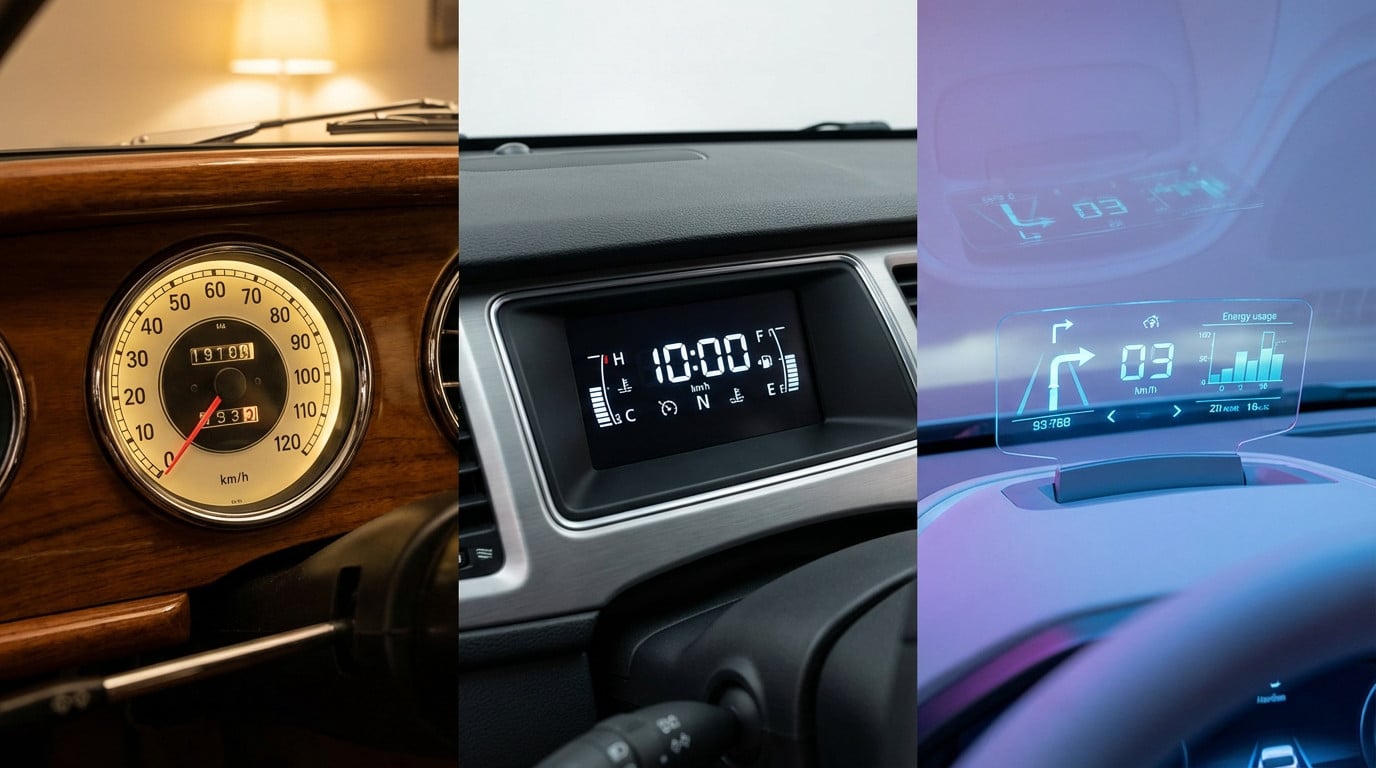
Have you ever questioned if the precise reading on your dashboard truly reflects your actual pace, or why manufacturers intentionally build in a hidden margin of error to subtly influence your driving? This comprehensive analysis explores the speedometer evolution, meticulously tracing the full technological journey from the tactile era of mechanical cables to the sophisticated digital interfaces of modern vehicles. We uncover the ingenious physics behind the spinning needle, explain the legal nuances of accuracy, and reveal how upcoming augmented reality technologies will soon completely redefine the way we perceive velocity behind the wheel.
The Mechanical Heartbeat: How Classic Speedometers Work
The Elegant Physics of the Eddy Current
You might think it’s magic, but early speedometer evolution relied on simple physics. A flexible cable connects the transmission to the dashboard. It spins a permanent magnet inside the gauge. The magnet’s rotation matches your car’s speed perfectly.
This spinning magnet creates a magnetic field. It induces electrical currents inside an aluminum cup called the speedcup. These eddy currents generate their own opposing magnetic drag.
That drag forces the cup to rotate, pulling the needle across the dial. A hairspring fights back to return it to zero.
The Core Components of a Mechanical Gauge
This system doesn’t need a computer to function. It relies on five key parts working in total harmony.
- The Drive Cable: A flexible shaft that transfers rotational motion from the gearbox.
- The Permanent Magnet: Rotates with the cable, creating the magnetic field.
- The Speedcup: An aluminum cup where eddy currents are induced, causing it to turn.
- The Hairspring: A fine torsion spring that provides counter-torque and returns the needle to zero.
- The Pointer and Dial: The visual interface for the driver.
More Than Just Speed: The Odometer Connection
That spinning cable does double duty for your dashboard. It also powers the odometer to track distance. It’s a logical integration of two distinct tools.
Inside, a worm gear slows down the cable’s high-speed rotation. This reduction allows the numbered wheels of the odometer to turn slowly. It tracks miles rather than revolutions per minute.
From Pricey Option to Dashboard Staple
The Early Days of Speed Measurement
Early automobiles lacked any gauge for pace; velocity was merely a sensation of wind against the face. While inventors like Josip Belušić explored similar concepts, the first patent is often attributed to Josiah Franklin Packard in 1902. This mechanical foundation kickstarted the speedometer evolution we recognize today.
Initially, these devices were pricey options, accessible only to the wealthy elite. The game changed around 1910 when manufacturers made them standard equipment. This shift transformed driving from a raw, unmeasured experience into a safer, quantified practice for the average motorist.
Pioneering Manufacturers and Timeless Design
A major player in this narrative was Otto Schulze Autometer (OSA). This German enterprise, which would eventually become part of Siemens, established itself as a critical supplier. They manufactured the specific OSA speedometer in 1923, setting a benchmark for precision engineering.
You might notice the layout hardly aged. The basic mechanical design—a rotating needle on a numbered dial—remained virtually unchanged for 60 years. It proves that simple utility often wins, a consistency mirrored in the evolution of professional auto sports where core principles persist.
The Speedometer as a Social Instrument
The 1979 oil crisis forced a rethink of the dashboard. Governments needed drivers to ease off the gas to conserve fuel. They realized the instrument panel could manipulate behavior, pushing for slower habits through design.
Take the Corvette C3 as a prime example. Its gauge was capped at 85 mph (137 km/h), with a loud accent on 55 mph. This design trick used visual psychology to make speeding feel physically impossible.
The Digital Revolution on the Dashboard
Goodbye Cables, Hello Sensors
The 1980s marked a sharp turn in speedometer evolution as manufacturers embraced digital tech. We saw the heavy mechanical cable replaced by compact electronic speed sensors. These components usually sit on the transmission or use the ABS system’s wheel sensors.
The ECU (Engine Control Unit) acts as the brain here. Those sensors shoot electronic pulses straight to the onboard computer. The ECU then calculates speed by reading the frequency of these pulses.
Finally, the speed appears on a digital screen. This provides much better readability, particularly when you drive at night.
Drivers of the Electronic Shift
This transition involved more than just modern aesthetics. Specific engineering and economic factors pushed the change.
- Reliability: Electronic systems have fewer moving parts, reducing wear and tear.
- Integration: Speed data could now be shared with other vehicle systems.
- Cost-Effectiveness: As electronics became cheaper, sensor-based systems became more viable.
- Design Freedom: Digital displays offered car designers more flexibility for dashboard layouts.
The Rise of the Multi-Information Display
Digital gauges evolved faster than anyone expected. They are no longer just about displaying speed. The instrument cluster has become the center of a complete information ecosystem.
Drivers now monitor fuel consumption and range instantly. The display also handles navigation instructions and vehicle alerts.
Accuracy, Legality, and the Modern Speed Reading
With this new technology came a lingering question that still haunts drivers today: is my speedometer actually accurate?
The Built-in Margin of Error
Most drivers assume their dashboard displays the absolute truth. That assumption is unfortunately wrong. Car manufacturers deliberately bake in a calculated margin of error. Your vehicle is almost always moving slower than the needle claims.
This happens because of strict mandates like UNECE Regulation 39. These rules forbid speedometers from ever showing a speed lower than reality. To avoid lawsuits, engineers calibrate systems to overestimate slightly. Safety simply trumps precision.
Factors That Influence Speedometer Accuracy
Even with factory calibration, accuracy is never guaranteed. External variables often skew the final reading.
While we trust these instruments, the speedometer evolution hasn’t eliminated every flaw. Different technologies handle data differently, and understanding these nuances prevents costly misconceptions.
| Technology | Working Principle | Common Inaccuracy Factors | Typical Accuracy |
|---|---|---|---|
| Mechanical | Eddy current via cable | Cable wear, spring fatigue | Can degrade over time |
| Electronic | Electronic pulses from sensor | Tire diameter, ECU calibration | Generally stable, ~2-5% overestimation |
| GPS-Based | Satellite triangulation | Signal loss, satellite lag | Highly accurate, but not legally certified for vehicles |
It is worth noting that changing your tire size is the most frequent cause of inaccuracy. A different diameter alters the wheel’s circumference, forcing the system to miscalculate the number of rotations needed for a given distance.
The Future of the Speedometer: More Than a Number
So, what does the future hold? The good old dial is giving way to solutions that seemed like science fiction just a few years ago.
The Rise of the Head-Up Display (HUD)
Let’s talk about the Head-Up Display (HUD). This tech throws vital data, including your current speed, right onto the windshield glass. It forces you to keep your eyes locked on the asphalt. Basically, it kills the need to look down.
What started in fighter jets and high-end luxury rides is finally hitting the mainstream. It’s a logical shift to boost safety and driver focus. You stop losing split seconds glancing at the dashboard.
Augmented Reality and the Intelligent Display
We can push this even further with augmented reality (AR). Future displays won’t just float static numbers in your face. They will overlay dynamic graphics directly onto your view of the real world. This marks a wild shift in speedometer evolution.
Picture navigation arrows that look like they are painted on the street. Or imagine a highlight glowing around the car ahead of you. Speed readouts could change color contextually, turning red the second you approach a danger zone.
Integration with Advanced Driver-Assistance Systems (ADAS)
Then there is the deep integration with advanced driver-assistance systems (adas). The speedometer stops being a passive gauge. It becomes an active participant in your daily safety.
Your car will read speed limit signs and adjust the display instantly. It might even nag you to slow down. This connection is vital, especially given the known challenges of driver assistance systems in bad weather.
From the rhythmic ticking of mechanical gears to the seamless projection of augmented reality, speedometer has evolved far beyond a simple dial. Today, it stands as a sophisticated nexus of safety and data. As we drive toward a more connected future, this humble instrument remains our most vital link to the road, blending tradition with cutting-edge innovation.