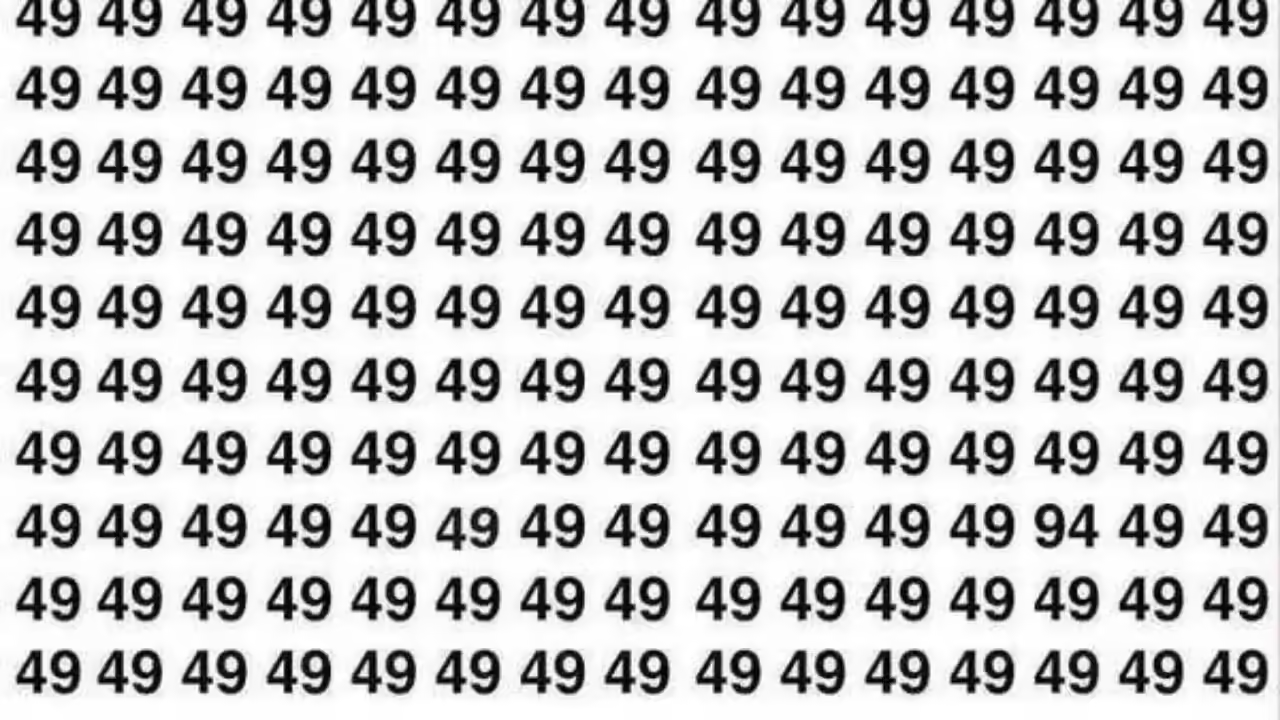
Looking for a vision test that delivers a real mental workout? This optical illusion puzzle has taken social media by storm, daring participants to spot the hidden number “94” tucked within a dense grid of “49s.” The challenge is simple but intense: locate it in just six or seven seconds. While this may sound straightforward, many are surprised by how this time challenge can trip up even those with a high IQ and keen observation skills.
What makes this visual brain teaser so engaging is its clever design. By repeating patterns, the illusion tricks the mind, making tiny differences—like switching two digits—almost impossible to detect at first glance. The real excitement comes when individuals realize they missed the correct answer not due to poor eyesight, but because their perception was expertly manipulated by the illusion’s layout.
What makes this optical illusion so tricky?
It might seem logical that anyone with sharp vision could breeze through such a quick vision test. Yet, this particular puzzle demonstrates how much our observation skills are put to the test in subtle and sometimes frustrating ways.
When numbers crowd together, the brain uses pattern recognition as a shortcut. Rather than examining every digit, the mind assumes sections are identical, allowing deceptive repetition to hide what matters most. In this image, dozens of 49s effectively mask a single 94, exploiting the tendency to organize chaos into familiar patterns instead of inspecting each detail.
Why does the brain struggle with repetitive layouts?
Human brains excel at spotting patterns quickly, which usually helps in daily life. However, with highly repetitive layouts, the mind expects uniformity and often skips over careful verification. This allows an optical illusion to mislead, especially when one element subtly breaks the pattern—such as a hidden number almost identical to the rest.
Many popular puzzles use this principle, introducing slight variations to catch even experienced solvers off guard. What seems like a straightforward visual skills exercise quickly becomes a lesson in how easily perception and focus can slip under pressure.
How do “hawk eyes” become the secret weapon?
Finding the answer in six seconds is uncommon. Those said to have “hawk eyes”—with both precise 20/20 vision and rapid observation—excel at picking out inconsistencies, no matter how minor. Such individuals instinctively slow down their attention, refusing to let familiarity cloud their scrutiny.
Success in these challenges often goes to those who focus on details, analyzing patterns rather than assuming everything is the same. These heightened observation skills are frequently tied to impressive problem-solving abilities and high-level pattern recognition.
The thrill and frustration of the time challenge
Inviting others to participate brings out the competitive spirit. Friends exchange tales about missing the hidden number until the last moment, while some proudly declare they found it instantly. The ticking timer adds excitement, transforming a basic vision test into a lively game.
For some, solving the puzzle within the brief window offers a satisfying boost of confidence. For others, repeated attempts become a personal mission—a way to sharpen mental agility and strengthen attention to detail.
Is speed or accuracy more important?
This visual puzzle rewards both fast thinking and steady nerves. Racing against the clock increases difficulty, often causing the brain to overlook essential details in favor of general patterns. Meanwhile, those who remain calm and systematically check corners and edges—frequent hiding spots—are more likely to succeed.
Confusing speed with skill leads many astray; taking a moment to question initial assumptions can be invaluable in any observation skills test.
What happens after discovering the solution?
Spotting the elusive 94 in the bottom right corner provides a genuine aha-moment. Sharing this discovery generates enthusiasm online, as people encourage friends and colleagues to see if their own “hawk eyes” measure up.
The communal aspect amplifies enjoyment, drawing new participants eager to try their luck. Each attempt weaves another story of triumph, laughter, and mild frustration as everyone tests their visual skills.
Testing eyesight and mental agility beyond the surface
Not all vision tests assess only physical sight. Challenges like this highlight both strong eyesight and the cognitive side of perceptual mastery. Perfect vision alone is not enough—it takes efficient interpretation to identify subtle anomalies in moments.
Optical illusions reveal how deeply sight and thought are connected. Searching for hidden elements, tracking minute changes, and maintaining focus in busy visuals push boundaries far beyond standard eye exams.
- This puzzle boosts attention to fine details, since every small variation counts.
- It encourages persistence and careful pacing, countering the urge to rush.
- Solving the challenge builds self-confidence and sparks conversations around visual skills and intelligence.
- Regular participation sharpens short-term focus and overall observation skills, proving useful well beyond entertainment.
Why the hidden number remains hard to spot
Many wonder why the secret 94 stayed invisible for so long, despite determined efforts. The answer lies in manipulating expectations. By filling most of the image with identical shapes, any change blends in seamlessly, barely registering in the pattern-seeking brain.
Even after learning where the answer sits, revisiting the puzzle reinforces strategies for breaking routine visual habits. Over time, exposure to these illusions stretches mental flexibility, helping viewers separate automatic judgment from mindful investigation.
How can perception training improve results?
Regularly tackling optical illusions leads to lasting improvements in cognitive agility. Practicing during time challenges trains the brain to prioritize fresh information over old habits. With experience, practitioners block distractions and spot discrepancies in crowded scenes more easily.
Some individuals adopt daily visual exercises to heighten sensitivity to tiny changes—not just for fun, but for practical uses in navigation, data analysis, or creative work. The more often these skills are tested, the more robust one’s observation and visual skills become.
Who benefits most from these optical challenges?
Anyone can benefit from practicing these puzzles—youngsters aiming to boost concentration, professionals working with detailed data, or those interested in brain health and resilience. Beyond entertainment, searching for the hidden number strengthens neural connections vital for memory, learning, and quick decision-making.
Those who embrace such challenges develop a blend of sharp vision, insightful thinking, and strategic patience—setting themselves up for stronger observation skills in everyday life.