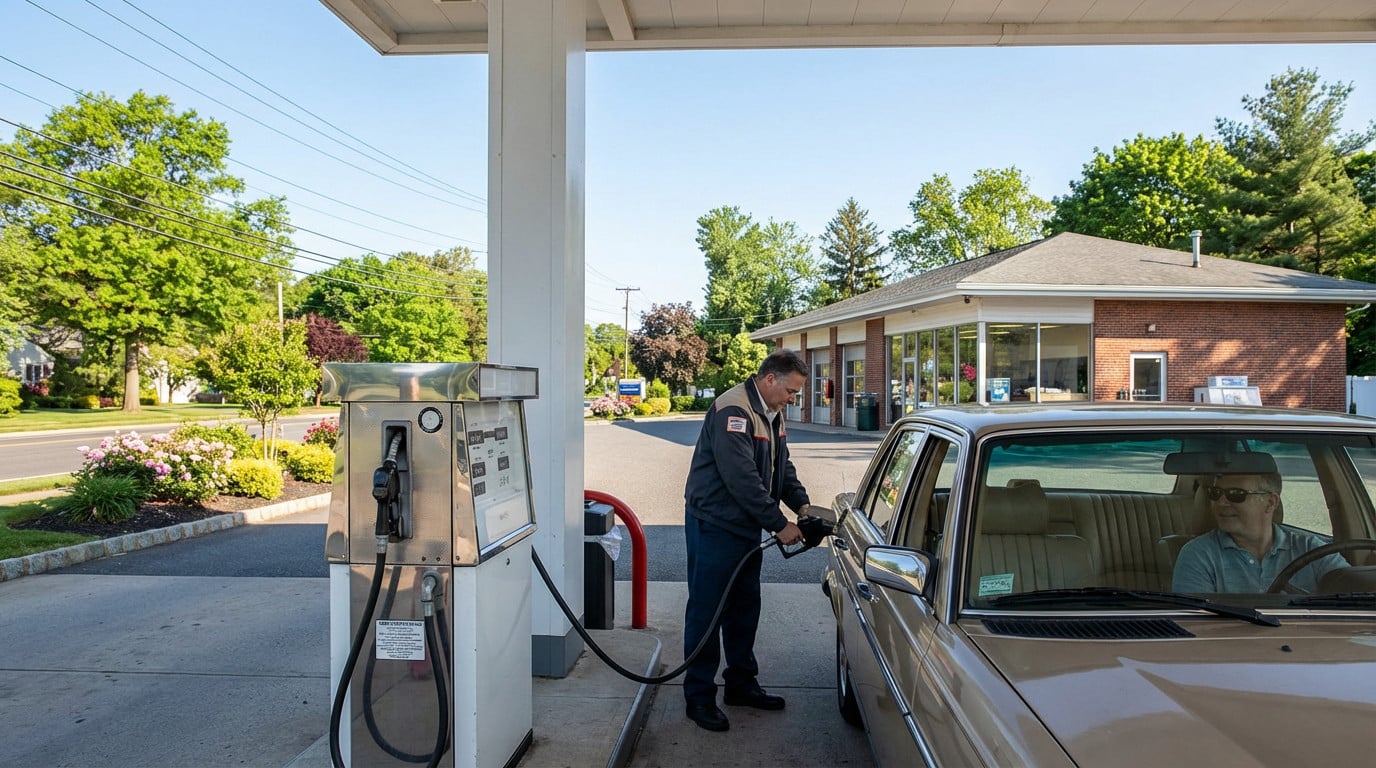
Have you ever questioned the true purpose of the new jersey self service gas ban, a singular regulatory quirk that legally prevents motorists from ever touching a fuel pump? We investigate the contentious origins of this 1949 mandate, uncovering a surprising blend of public safety rhetoric and calculated economic protectionism designed to eliminate discount competitors. By tracing the timeline from the rebellious Irving Reingold era to today’s legislative stalemate, we expose the specific political forces and market dynamics that preserve this outlier law long after other states have moved on.
A Story of Safety, Sabotage, and Gas Prices
The Official Story: The 1949 Safety Act
Officially, New Jersey banned self-service in 1949. Legislators passed the Retail Gasoline Dispensing Safety Act strictly for public safety. Lawmakers cited grave concerns about fire risks. They claimed untrained drivers couldn’t handle gasoline safely.
This narrative became the state’s standard defense. Politicians have repeated this safety argument for over seventy years. It remains the polite, public-facing justification for the law.
The Real Story: The Irving Reingold Affair
Journalists like Paul Mulshine tell a different, grittier tale. The actual motivation was purely economic protectionism. Enter Irving Reingold, a bold entrepreneur. He disrupted the status quo in 1949.
Reingold opened a massive 24-pump station in Hackensack. He offered self-service gas at 18.9 cents a gallon. His furious competitors charged 21.9 cents.
Rivals pressured lawmakers to crush this threat. They fast-tracked the new jersey self service gas ban to force Reingold out. This move successfully secured higher prices for the industry.
The Table That Tells All
You need to see the contrast to believe it. This table exposes the gap between the stated law and the actual intent. Here is the breakdown of the 1949 conflict.
| Aspect | Official Justification (Public Safety) | Suspected Real Motive (Economic Protectionism) |
|---|---|---|
| Primary Goal | Prevent fires and accidents from untrained drivers handling gasoline. | Eliminate price competition from low-cost, self-service stations. |
| Key Figure | The ‘incompetent’ general public. | Irving Reingold, the discount gas station owner. |
| Immediate Outcome | Enhanced public safety at gas pumps. | Forced Reingold out of business and stabilized higher gas prices. |
An Unrepealable Law? A History of Failed Attempts
Early Resistance and Legal Battles
Resistance to the new jersey self service gas ban kicked off almost immediately. Legislators tried to scrap the rule as early as 1951, yet every single push hit a wall.
A major court fight erupted in 1988. The Kirschner Brothers Oil Company sued the state, claiming the statute was “outdated” and killed consumer choice. Surprisingly, a Superior Court judge actually sided with them.
But that win didn’t last long. An appellate court reversed the decision, pointing back to a 1951 Supreme Court ruling.
The Political Crusade of Key Figures
Outside the courtroom, the battle raged in the political arena too. Senator Gerald Cardinale emerged as the most vocal champion against this restriction.
Starting in 1981, he introduced bill after bill to kill the ban. He never gave up. Yet, despite his relentless push over several decades, not one of his proposals ever made it to the governor’s desk.
This track record of failure proves just how stubborn this law is. It seems untouchable. You might wonder why politicians keep trying when the ban clearly isn’t going anywhere. It draws its inspiration from deep-seated habits.
- Key moments in the fight against the ban:
- 1951: First legislative attempt to repeal the law fails.
- 1981: Senator Gerald Cardinale begins his decades-long legislative push for self-service.
- 1988: Kirschner Brothers Oil Co. sues the state, wins initially, but is overturned on appeal.
- Present Day: The “Motorist Fueling Choice and Convenience Act” is the latest.
The Last Holdout: How New Jersey Became One of a Kind
When Oregon Left the Club
For decades, the Garden State had a partner in crime. Until recently, Oregon also enforced a strict ban on pumping your own fuel. It was a shared quirk that bonded the two coasts.
But the tide turned out West. In 2015, Oregon started loosening its grip in rural counties. Then, in 2023, legislators finally dropped the prohibition across the entire state. It was the end of an era.
That shift left New Jersey completely isolated. It is now officially the only US state where touching a gas nozzle remains a crime for the average driver.
A Political “Third Rail” and Public Opinion
Why does this old law survive? Touching the new jersey self service gas ban is a political “third rail” here. Elected officials know that suggesting a repeal invites immediate voter fury. It is simply too risky to attempt.
Surprisingly, locals actually defend the mandate with passion. Polling data consistently proves that a solid majority prefers staying inside their warm cars while someone else does the work.
This attachment blends pure convenience with stubborn habit. It defines the local lifestyle, much like the endless arguments over state-specific road sign costs. It is a strange badge of honor that residents refuse to give up. They like it.
- The current debate: Two sides of the coin
- Arguments for keeping the ban:
- Protects jobs for thousands of gas station attendants.
- Provides convenience, especially in bad weather.
- Perceived safety for drivers who prefer not to handle pumps.
- Arguments against the ban:
- Denies consumer choice.
- Potentially keeps gas prices artificially high.
- archaic law in a modern world.
The Price of Full Service: What the Ban Means Today
The Economic Ripple Effect
This prohibition is not free. Economic studies suggest that mandatory service leads to higher retail margins, estimated between 3 and 5 cents more per gallon. It is a cost the consumer pays directly at the pump.
The law also influences the types of gasoline stations we see. It has effectively curbed the expansion of large stations with convenience stores, which are typically more capital-intensive.
Conversely, it makes labor-intensive services, like auto repair shops, more viable. It is a dynamic similar to that of other small service businesses.
Rules of the Road: Fines, Exceptions, and Etiquette
And don’t think about breaking the rule. Attempting to pump gas yourself can end up costing the station owner dearly.
The law mandates specific fines for stations that ignore the New Jersey self service gas ban. It is a strict rule, even if some exceptions exist for diesel fuel or private stations not open to the public.
This raises the question of etiquette: should you tip? There is no rule, but it is a gesture appreciated for the service rendered.
- Violating the ban: The penalties for gas stations
- First Offense: Fine up to $250.
- Subsequent Offenses: Fine up to $500.
Ultimately, New Jersey stands alone as the final bastion of full-service fueling. While economic arguments challenge this relic of 1949, the ban remains deeply woven into the state’s identity. We continue to sit back and wait for the attendant, preserving a unique, if controversial, slice of American automotive history.