Have you ever felt confused by the subtle technical differences fueling the highway vs freeway debate during your daily commute? We clarify this distinction by examining how strict access controls and specific design choices separate a standard public road from a high-speed thoroughfare. You will discover the precise speed limits and engineering standards that dictate the flow of traffic on these major arteries.
The Fundamental Divide: Access Control Defines Everything
The Simple Rule: All Freeways Are Highways
Let’s settle the highway vs freeway debate immediately. A highway is simply the broad umbrella term for any public road. A freeway, however, is a specific, stricter category within that family. Essentially, every freeway is a highway, but the reverse isn’t true.
The Manual on Uniform Traffic Control Devices (MUTCD) explicitly defines a freeway as a specific type of divided highway. This isn’t just semantics; it is a codified engineering distinction that dictates how we drive.
The confusion stems from people swapping these terms casually, blurring the technical lines completely.
What Truly Makes a Freeway “Free”
Here is what most drivers get wrong. The “free” doesn’t refer to toll costs. It refers to uninterrupted traffic flow. You are meant to move continuously without stopping.
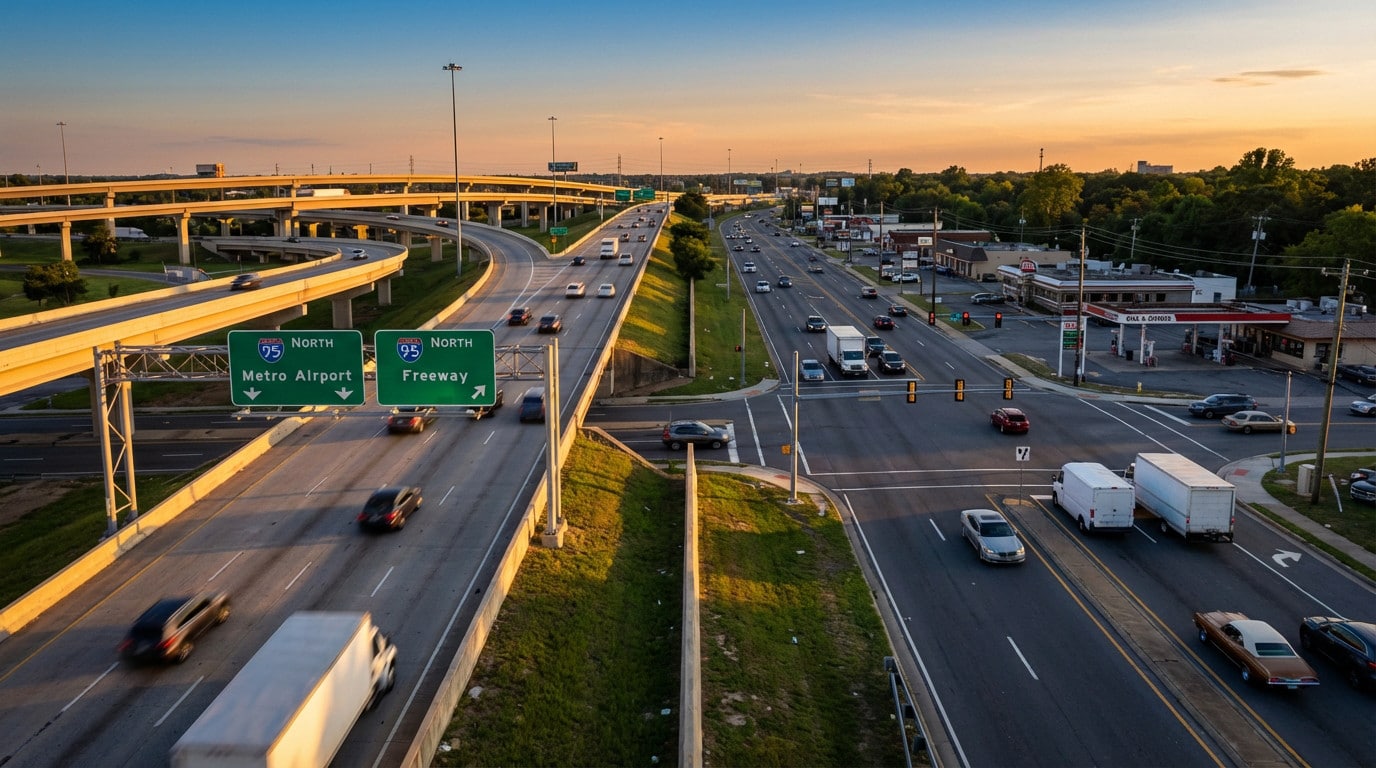
This flow is achieved through full control of access. You won’t find at-grade crossings, traffic lights, or driveways leading directly to a house. The road is isolated from the environment to prioritize speed.
Instead, we rely exclusively on on-ramps and off-ramps to enter or exit the system safely.
The Defining Features of a Freeway
If you are unsure what you are driving on, look for these non-negotiable characteristics that define the infrastructure.
- Total absence of at-grade intersections, traffic lights, or stop signs.
- Access and exit solely via interchange ramps (on/off-ramps).
- Presence of a physical separation (median).
- Prohibition of pedestrians, cyclists, and slow-moving vehicles.
Design and Flow: The Driving Experience
Now that the technical distinction is clear, let’s see how this translates concretely for the driver in terms of speed and road design.
Speed Limits: A Clear Indicator
Freeways are built for speed, plain and simple. They allow for uninterrupted travel across vast distances. In the US, a typical three-lane freeway pushes limits from 65 to 80 mph (105-129 km/h). It is all about efficiency.
Highways tell a different story regarding velocity. You will generally find a cap of 55 mph (89 km/h). This lower pace is necessary because of the potential for sudden interruptions.
On rural or two-lane stretches, limits drop even further. Sharp turns or steep grades make high speeds dangerous.
Traffic Control and Intersections
Freeways prioritize a continuous flow above all else. Their linear design connects urban zones without forcing you to hit the brakes. It is all about keeping momentum.
Highways, however, are designed to handle cross traffic. Secondary roads connect directly at various points. This setup demands strict control systems. They manage the intersections and reduce collision risks.
You will frequently encounter these specific interruptions:
- Traffic lights
- Stop signs
- Roundabouts
- Direct access from businesses or homes
On-ramps, Off-ramps, and Lane Discipline
Controlled-access routes rely heavily on specific ramp systems. Entrance ramps feature an acceleration lane to merge safely. Exit ramps, conversely, force you to decelerate rapidly.
Proper etiquette keeps things moving safely. Use the left lane strictly for passing slower vehicles. This discipline maintains traffic fluidity and prevents gridlock.
The Extended Family: Expressway, Parkway, and Turnpike
But the terminology doesn’t stop at just highway vs freeway distinctions. To really master road jargon, you have to understand where expressways, parkways, and turnpikes fit into the mix.
Decoding the Road Hierarchy
This table breaks down the nuances between main high-speed road types. It provides a quick reference to clear up any lingering confusion.
| Road Type | Access Control | Intersections/Traffic Lights | Typical Use | Key Feature |
|---|---|---|---|---|
| Highway | Variable (from none to partial) | Yes, possible | General purpose, connects towns and cities | Broadest, most general term |
| Freeway | Full/Total | None | High-speed, uninterrupted travel between major areas | The highest standard of controlled-access road |
| Expressway | Partial (some direct access or intersections may exist) | Sometimes, but limited | A step down from a freeway, often bypassing urban centers | A hybrid between a highway and a freeway |
| Parkway | Usually full or partial | Rare | Scenic or recreational routes | Often has commercial vehicle restrictions and lower bridges |
| Turnpike | Full | None | Long-distance, high-speed travel | It’s a toll road (a freeway or expressway you pay to use) |
Context Is King: Regional Terms and Global Benchmarks
Beyond technical definitions, the way we speak about roads shifts geographically, and some nations really test the limits of what ‘fast’ means.
Why the Words You Use Depend on Where You Are
You might notice terminology swings wildly depending on your location. Take California, for instance. Locals there use “freeway” as the default term for any major route, even technically distinct interstates. It’s just how the West Coast talks.
Compare that to the East Coast or Midwest, where “highway” reigns supreme. This regional habit creates massive confusion between the terms for travelers. You’re often driving on the same type of road, just named differently.
Common Myths and Interesting Facts
Let’s kill a popular rumor right now. Despite what your uncle told you, the Interstate system was not designed as airstrips for military planes. That is purely an urban legend.
Innovation doesn’t always work out immediately. A French experiment with solar panels integrated into roads proved the tech needs significant work. It simply wasn’t ready for mass application yet.
Technically, “controlled-access highway” is the real boss here. This umbrella term covers interstates, freeways, and expressways alike. It unifies them under one banner of strict traffic regulation and limited entry points.
The Gold Standard of Speed: The Autobahn
When we talk about going fast, the German Autobahn stands alone. Spanning nearly 8,000 miles, it holds the world’s highest average traffic speed. Drivers there clock in at a staggering 88 mph (approx 142 km/h) on average.
It’s not a total free-for-all, though. Authorities do suggest a pace to keep things safe.
- Advisory speed sits at 81 mph (130 km/h).
- Amazingly, about half the network has no speed limit posted.
Ultimately, the distinction between a highway and a freeway relies entirely on access control. While we often use these terms interchangeably, only the freeway offers the uninterrupted flow that defines high-speed travel. Recognizing these nuances not only clarifies our road lexicon but ensures a safer, more predictable journey on any route.