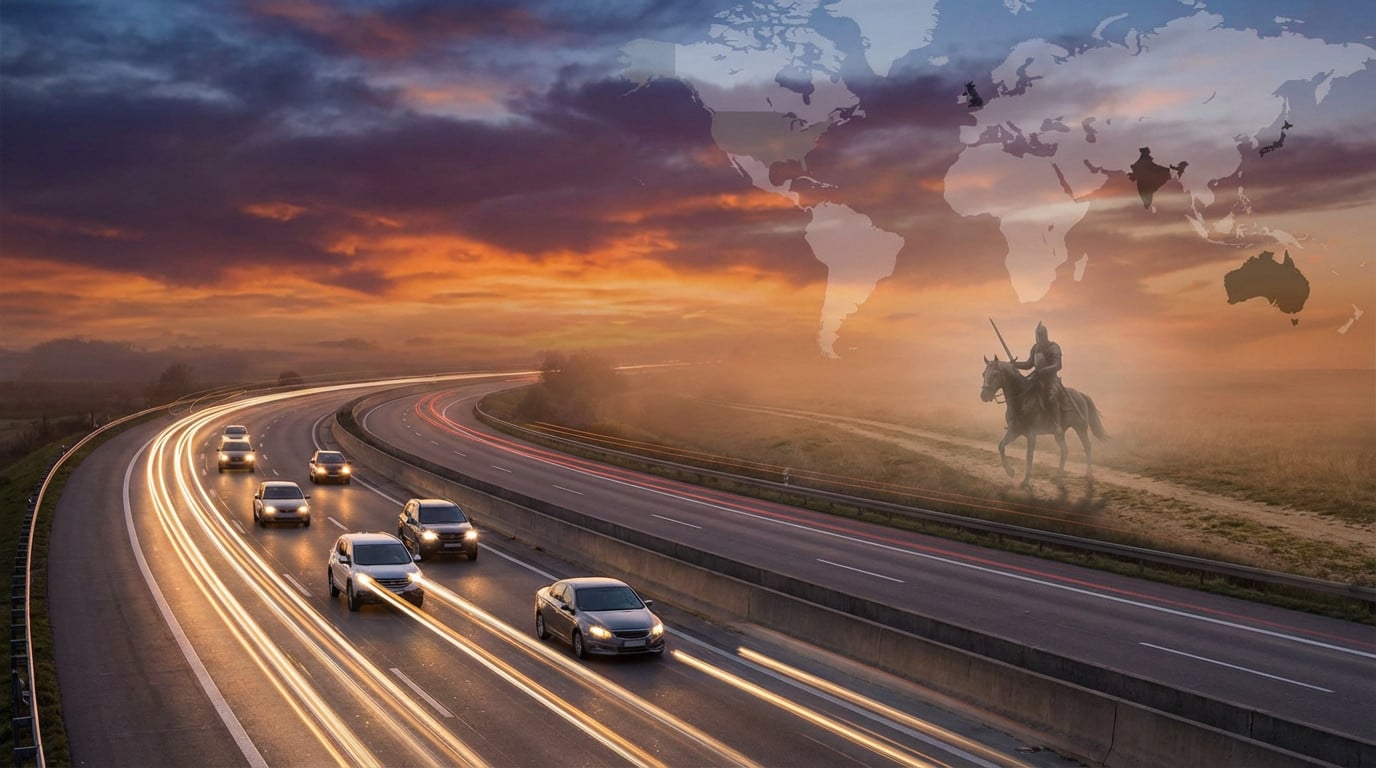
Have you ever gripped the steering wheel with white knuckles, terrified that a momentary lapse in concentration might send you drifting into oncoming traffic abroad? Investigating the driving on left history explains why medieval swordplay and colonial logistics established the distinct traffic flow that persists across seventy nations today. We detail the specific origins of this split and provide a complete geographical guide, equipping you with the necessary knowledge to safely negotiate roundabouts and intersections on the left side of the road.
The Ancient Roots of Keeping Left
A Matter of Swords and Safety
You might think driving on left history starts with cars, but it doesn’t. The habit actually dates back to medieval times. Since most people were right-handed, knights wore their heavy swords on their left hip.
Passing oncoming traffic on the left made perfect sense. It kept their right hand—the sword hand—free and facing any potential opponent. This was a natural defensive stance.
It also stopped scabbards from banging together. In those days, touching swords was a direct provocation.
Roman Roads and the Rule of the Majority
Deep ruts found in ancient quarries suggest the Romans likely drove on the left too. It wasn’t just a random choice. The archaeological evidence points to a deliberate system.
Consider the driver’s perspective. Most carters were right-handed, holding reins in the left to keep the right hand free for the whip. Sitting on the right provided the best view of the road edge.
This practice, rooted in the right-handed predominance, established a standard. It became the norm long before official laws existed. Humans simply followed their physical instincts.
London Bridge and the First Traffic Regulations
Eventually, custom had to become law. One of the very first official traffic regulations appeared in London during the 18th century. The chaos needed sorting out.
Traffic on London Bridge had become a nightmare. A specific act was passed in 1756 requiring all traffic to keep left to ease the flow. It formalized an existing habit.
This rule served as the model for the Empire. It effectively locked left-hand traffic into place worldwide.
How the World Split: The Great Divide of Right vs. Left
But if keeping left was so logical, why does the majority of the world drive on the right today? The answer lies in a series of historical, political, and even technical ruptures.
Napoleon’s Push for the Right
You can attribute a massive chunk of the shift away from driving on left history to Napoleon Bonaparte. Before him, French traffic was anarchic, though the aristocracy tended to keep left.
Here is the theory: Napoleon was left-handed, so mounting a horse and drawing a sword from the right felt natural. Another view is that he reversed his cavalry charges to shock the enemy.
He then imposed conduit à droite across his conquered territories, from Switzerland to Germany, creating a sharp divide with Britain.
America’s Teamsters and the Freight Wagon Factor
In the US, the adoption of right-side driving wasn’t a political statement but a practical necessity. It is directly linked to the massive freight haulers known as Conestoga wagons.
These wagons had no driver’s seat. The teamster sat on the left rear horse, keeping his right hand free to whip the team.
From that position, it was much easier to monitor oncoming traffic by keeping to the right side of the road. This habit eventually became the standard.
The Ford Model T and the Standardization of the Driver’s Side
The nascent auto industry played the final role in standardization. Henry Ford made a choice that changed everything.
Henry Ford decided to mass-produce his Model T with the steering wheel on the left. His logic was that passengers, especially women, could exit directly onto the curb, avoiding the road’s mud.
The Model T’s dominance cemented the standard of a left-hand wheel for right-side driving, influencing neighbors like Canada to align.
- The political influence of Napoleon across Europe.
- The practical requirements of American freight wagons.
- The industrial standardization led by Ford.
The British Empire’s Lasting Legacy on the World’s Roads
While France and America charted the course for right-hand traffic, another global superpower carved its own standard across a quarter of the globe: the British Empire.
Exporting the Rule of the Road
Let’s cut to the chase. The primary reason a massive chunk of the world still drives on the left isn’t random chance—it is the direct footprint of the British Empire.
Wherever the British planted their flag—from the dusty roads of Australia to the bustling streets of India and South Africa—they imported their specific laws and customs. Naturally, this included the driving on left history and road codes.
It wasn’t just about preference; it was a rigid matter of standardization and tight administrative control.
From Military Convoys to Colonial Administration
Look at the logistics. Driving on the left streamlined the movement of massive British military convoys across vast territories. It kept supply lines organized and predictable, preventing chaos in areas where order was everything.
This military order quickly bled into settler life and civil administration. It became the unquestioned norm for everyone, serving as a powerful tool for imperial unification.
The influence was so strong that even former German colonies in Africa, like Tanganyika, had to switch sides to align with the British mandate after World War I.
Post-Colonial Persistence: Why the Habit Stuck
You might wonder why these nations didn’t flip the script after independence. The answer is brutally simple: sheer inertia and the terrifying financial cost.
Flipping a country’s traffic flow is a monumental and costly nightmare. You have to rip out every sign, rebuild road infrastructure, and somehow re-educate millions of drivers without causing mass casualties.
For most former British colonies, keeping the left-hand legacy was just the smarter, more logical move.
The Complete Map of Left-Hand Drive Countries Today
A Global Minority: Who Drives on the Left?
The driving on left history covers a third of the global population. This includes roughly 70 territories, ranging from demographic giants like India to economic powers like Japan and the UK.
The Comprehensive List of Left-Driving Nations and Territories
Here is the regional breakdown. Consult this list before you rent a vehicle abroad to avoid surprises.
| Region | Countries and Territories |
|---|---|
| Europe | Cyprus, Ireland, Malta, United Kingdom (England, Scotland, Wales, Northern Ireland), Channel Islands, Isle of Man. |
| Africa | Botswana, Eswatini, Kenya, Lesotho, Malawi, Mauritius, Mozambique, Namibia, South Africa, Seychelles, Tanzania, Uganda, Zambia, Zimbabwe. |
| Asia | Bangladesh, Bhutan, Brunei, Hong Kong, India, Indonesia, Japan, Macau, Malaysia, Maldives, Nepal, Pakistan, Singapore, Sri Lanka, Thailand, East Timor. |
| South Pacific / Oceania | Australia (Christmas Island, Cocos Islands, Norfolk Island), Fiji, Kiribati, Nauru, New Zealand (Cook Islands, Tokelau), Niue, Papua New Guinea, Pitcairn Islands, Samoa, Solomon Islands, Tonga, Tuvalu. |
| Americas & Other Territories | Anguilla, Antigua and Barbuda, Bahamas, Barbados, Bermuda, British Virgin Islands, Cayman Islands, Dominica, Falkland Islands, Grenada, Guyana, Jamaica, Montserrat, Saint Helena, Saint Kitts and Nevis, Saint Lucia, Saint Vincent and the Grenadines, Suriname, Trinidad and Tobago, Turks and Caicos Islands, US Virgin Islands. |
When countries switch sides: the stories behind the change
This map isn’t frozen in time. Over the decades, several countries have made the bold decision to change sides of the road, often for very pragmatic reasons. It sounds like madness to flip an entire nation’s traffic flow overnight, yet governments take this risk more often than you’d expect.
Sweden’s ‘dagen h’: the biggest traffic switch in history
You might think traffic laws are immutable, but Sweden proved everyone wrong. The most famous flip is undoubtedly Dagen H, or H-Day. It stands as the single biggest traffic switch in history.
Back in 1967, the Swedes swapped from left to right. Why did they bother with such a headache? Simple peer pressure played a huge role here. All their neighbors, like Norway and Finland, were already driving on the right side.
This wasn’t a gradual shift; it happened in one night. The entire country stopped, switched lanes, and restarted. It was a massive gamble that actually paid off without chaos.
Samoa’s pragmatic shift for cheaper cars
Let’s fast forward to a more recent, odd case: the islands of Samoa. In 2009, the country decided to buck the global trend. They flipped from the right side back to the left.
The motivation wasn’t safety; it was purely about money. This move allowed locals to import cheaper used cars from Australia and New Zealand. Since those big neighbors drive on the left, Samoa wanted in on that affordable market.
It proves that driving on left history isn’t just tradition. Sometimes, cold hard cash dictates the rules of the road.
The slow fade: countries that moved to the right
Throughout the 20th century, the tide mostly flowed one way. Countries slowly abandoned the left to harmonize with neighbors. It makes crossing borders much less of a headache for everyone involved.
Take Canada, where provinces ditched the left one by one to align with the United States. It wasn’t just them; places like Korea shifted right after World War II. Standardization usually wins in the end.
Tradition often loses to the pressure of conformity. If your neighbors drive right, you eventually will too.
The Driver’s Seat: What It’s Really Like to Drive on the ‘Wrong’ Side
Rewiring Your Brain: The Mental Challenge
We often underestimate the sheer force of habit behind the wheel. While the driving on left history explains the rules, your brain fights this reality at every turn. It demands absolute, exhausting mental focus. Old habits die hard.
You might drift toward the right on an empty country road. Exiting a gas station often triggers a panic moment where you aim for the wrong lane. It happens fast.
Even walking requires a hard reset of your survival instincts. You step off the curb looking left, but the danger approaches from the right. It catches you off guard.
The Right-Hand Drive Cockpit Experience
Sliding into the “passenger” side to drive feels undeniably strange. In these nations, the steering wheel sits firmly on the right. This shifts your entire perspective of the road ahead.
You gain a better view of the curb and oncoming traffic. But your left hand must now manage the gear stick. This awkward shift disrupts your muscle memory completely. It feels clumsy and unnatural for the first few miles.
Manufacturers often flip the indicator and wiper stalks too. You signal a turn, but the wipers start thrashing across the glass. It screams “tourist” to everyone watching.
Navigating the World in Reverse: Roundabouts and Junctions
Roundabouts represent the ultimate test of your new reflexes. You must enter and flow in a clockwise direction.
Your eyes naturally dart left, but death comes from the right. You must force your head to check the correct danger zone. Priority traffic barrels down from that side.
Right turns now involve crossing oncoming traffic, making them the dangerous maneuver. Left turns become the easy, safe option. This inversion of logic disorients even experienced pilots. Even advanced driver assistance systems struggle with these reversed geometries.
You need to keep a mental checklist to survive these roads. The challenge goes beyond simple steering adjustments. Here is what you face.
- Managing roundabouts in a clockwise direction.
- Handling inverted controls like gear sticks and indicators.
- Fighting the reflex to drift into the wrong lane.
- Maintaining increased vigilance at every intersection.
Your Car in a Left-Hand World: Adapting Your Vehicle for Travel
If driving a local car is already a challenge, imagine crossing the Channel with your own vehicle. While the driving on left history is distinct, your car isn’t designed for it, and a few adjustments are indispensable.
The Headlight Problem: Avoiding Blinding Other Drivers
Let’s talk about the main issue here: your headlights. A car built for right-hand traffic has an asymmetrical beam pattern. It naturally throws more light to the right side of the road. This design prevents blinding oncoming drivers.
When you switch to driving on the left, that same beam shines directly into the eyes of oncoming traffic. It is dangerous and illegal. You are effectively blinding everyone approaching you.
Adapting your lights isn’t just a polite suggestion. It is a strict legal requirement in many places like the UK. You could face fines if you ignore this rule.
How to Adapt Your Headlights
Fortunately, there are several ways to correct this light beam orientation. You don’t need a mechanic for most of them.
The most common fix involves using beam deflectors. These are specific stickers you apply directly to the glass of your headlamp. They block the dazzle effectively.
Some modern vehicles allow manual adjustment via the onboard computer settings. That is the easiest method. As a last resort, opaque adhesive tape can work, though it is far less precise.
- Check your vehicle manual for a possible electronic adjustment setting.
- Purchase and apply beam deflectors suited to your specific model.
- Remember to remove them upon return to avoid the opposite problem.
The Rental Option: Why Hiring a Local Car is Often Smarter
For most travelers, the best option is leaving your car at home. Renting a vehicle locally simplifies everything immensely. It’s part of good preparation, just like knowing the truth about your car’s oil change interval.
A local rental car will have the steering wheel on the right. This setup improves visibility significantly. It makes positioning yourself on the road much more natural.
We highly recommend choosing a car with an automatic gearbox. This eliminates the challenge of shifting gears with your left hand. You can focus entirely on the road.
The Oddities and Exceptions: Where the Rules Get Blurry
But as with any rule, the history of left-hand driving has its exceptions, gray areas, and downright bizarre situations that defy the binary logic of left versus right.
One Country, Two Systems: The Case of China, Hong Kong, and Macao
China presents a strange twist in driving on left history. While Mainland China strictly adheres to right-hand traffic, its Special Administrative Regions refuse to conform, clinging to their own inherited traffic systems despite political reunification.
It comes down to colonial ghosts. Hong Kong drives on the left, a remnant of British rule, while Macao follows suit, preserving the system left behind by the Portuguese.
To manage this chaos, engineers designed specific infrastructure like the Lotus Bridge. Here, lanes physically loop over each other, forcing cars to switch sides smoothly before crossing the border.
Driving on the Left in a Left-Hand Drive Car
Here is another head-scratcher: territories where the law says drive left, but the cars are built for the right. The equipment fights the environment.
Take the US Virgin Islands. They drive on the left—a local custom—but import cars from the US mainland. Consequently, almost every vehicle is Left-Hand Drive (LHD), placing the steering wheel on the ditch side.
You see the problem? The driver sits on the curb side, making overtaking practically impossible without swinging blindly into oncoming traffic.
The Legal Gray Area of ‘Wrong-Hand Drive’ Cars
Driving a car with the steering wheel on the “wrong” side is often legal, but it comes with strings attached. Authorities usually require headlight adjustments to stop beams from blinding oncoming drivers.
Yet, market forces often override convenience. In parts of Russia and Eastern Europe, drivers flood the roads with affordable, high-quality used RHD imports straight from Japan.
It saves money, but the cost is safety. You suffer from significantly reduced visibility during overtaking maneuvers on two-way roads, creating a genuine hazard.
Whether navigating the historic lanes of Britain or the bustling streets of Tokyo, driving on the left remains a fascinating testament to our shared past. By understanding these unique rules and adapting our habits, we ensure safer journeys. Let us buckle up, adjust our perspective, and confidently embrace the road less traveled.