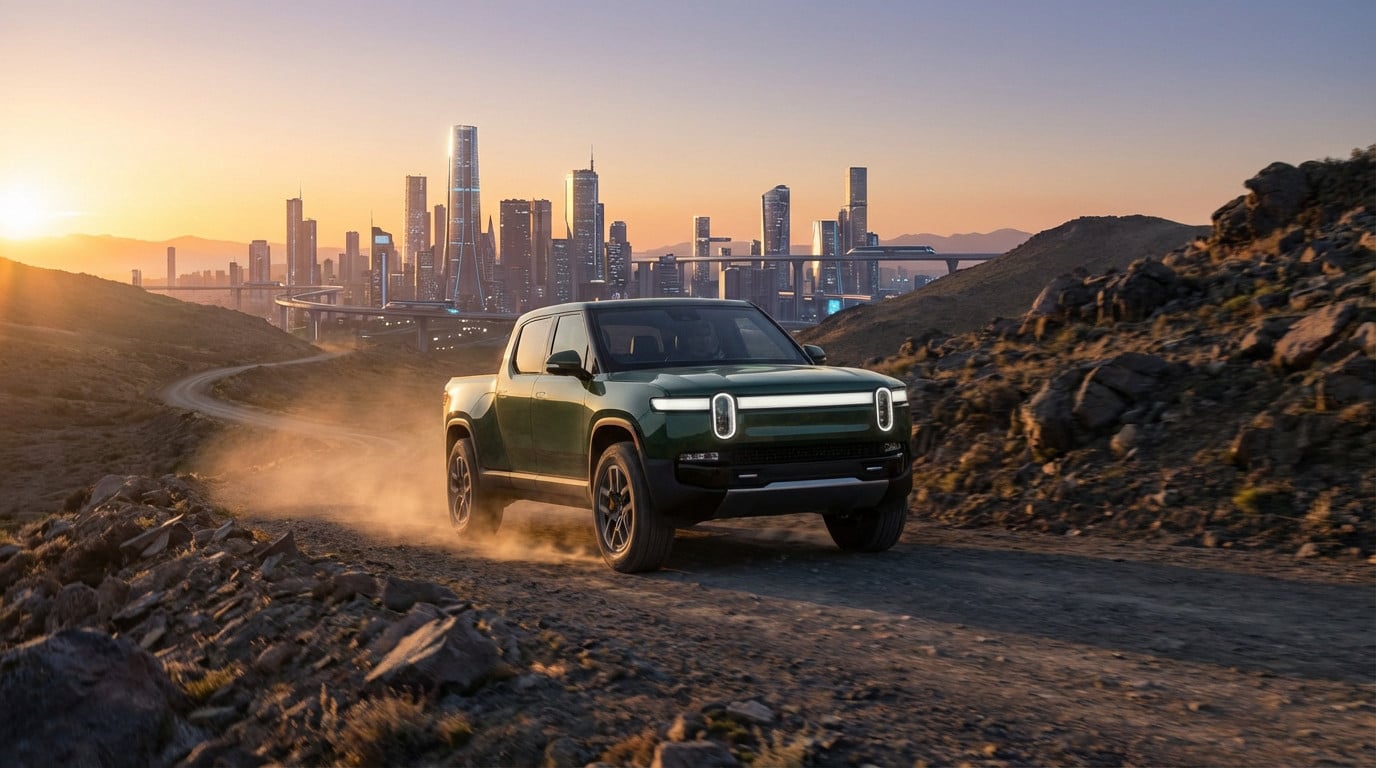
Is the promise of a rugged, zero-emission pickup finally a tangible reality for the modern adventurer? We evaluate the true rivian electric vehicle potential by dissecting the R1T’s technical prowess and its strategic positioning against established industry giants. Expect an unvarnished look at the engineering feats and scaling hurdles that will determine if this ambitious challenger ultimately thrives.
More Than Just a Truck: Rivian’s R1T as a Market Disruptor
The ‘Adventure Vehicle’ Niche That Tesla Missed
The R1T isn’t a workhorse; it is a dedicated adventure vehicle. It targets outdoor enthusiasts and urban families who prioritize lifestyle over hauling drywall. Plus, it actually fits inside a standard American garage.
Its capabilities are frankly absurd for a pickup. We see a sprint from 0 to 96.6 km/h in 3 seconds. It handles a towing capacity of 4,990 kg with ease. The off-road prowess makes it unstoppable on trails.
You get features that simply don’t exist elsewhere.
- Wading depth of 0.9 meters
- Unique ‘Gear Tunnel’ storage
- Integrated camp kitchen option
First to Market, First to Mind
Rivian became the first manufacturer to deliver an electric pickup to actual driveways. They beat giants like Ford and GM to the punch. Even Tesla watched from the sidelines.
This timing gave them a massive strategic edge. The R1T became the benchmark for every competitor, including the F-150 Lightning. It set the standard for being the first on the market.
RJ Scaringe founded the company back in 2009. They operated quietly for nearly a decade.
An IPO That Shook Detroit
The market responded with a massive $12 billion IPO. Rivian’s valuation briefly soared past $100 billion in a frenzy. That placed a startup above Ford and General Motors. It was a wake-up call for Detroit.
Big players validated this vision long before the public offering. Amazon (20%) and Ford (12%) poured capital into the venture. They recognized the rivian electric vehicle potential early on.
This cash fueled their massive ambitions. It also created immense pressure to deliver.
The Real Engine: Rivian’s Bet on a Vertically Integrated Tech Stack
You might think the bodywork is the main event, but the rivian electric vehicle potential actually lives elsewhere. It is under the hood, in the code and silicon, that the most interesting game is played.
More Tech Company Than Car Company
Rivian isn’t just bending metal; they are building a dynamic technology platform. They prioritize software development as the primary engine for future value. It is a fundamental shift in mindset.
This philosophy births their zonal architecture. They slashed the number of Electronic Control Units (ECUs) from seventeen down to just seven. This consolidation simplifies everything drastically. It also cuts manufacturing costs by thousands per vehicle.
Such a streamlined setup allows for constant Over-the-Air (OTA) updates. Your truck actually gets better the longer you own it.
Building Its Own Brain: The RAP1 Chip and LiDAR
Most manufacturers just buy parts off the shelf, but Rivian takes the hard road. They insist on vertical technological integration. They build their own hardware to control the entire stack.
At the center sits the proprietary RAP1 processor. It acts as the brain for their autonomy system. This custom silicon gives them a massive edge over legacy competitors.
They also made a bold choice to integrate LiDAR sensors. While Tesla gambles on “vision only,” Rivian adds this layer for safety. It introduces textures of data that cameras simply miss.
- The complete driver assistance system includes:
- 11 high-resolution cameras
- 5 radars for 360° perception
- addition of LiDAR for redundancy and precision
From One-Time Sale to Recurring Revenue
This tech stack does more than drive the truck; it drives the business model. It opens the door to massive recurring revenue streams. The upcoming “Autonomy+” subscription is the key here. It changes the financial equation completely.
Their roadmap is aggressive yet clear for the near future. We will see a hands-free system arrive in 2025. By 2026, they aim for Level 3 “eyes off” capability.
Navigating the Battlefield: Competition and Scaling Challenges
Having a great piece of technology is one thing, but mass-producing it and selling it against fierce competition is a whole different ball game.
The Electric Truck Showdown
The rivian electric vehicle potential is tested as the market becomes a literal war zone. Rivian faces massive, entrenched titans.
You need to see the hard numbers to understand the disparity here. Check out this breakdown of the current heavyweights fighting for your driveway.
| Feature | Rivian R1T | Tesla Cybertruck | Ford F-150 Lightning | GMC Hummer EV |
|---|---|---|---|---|
| Target Price (Approx.) | ~$70,000 | ~$61,000 | ~$55,000 | ~$96,000 |
| Max Range (Est.) | ~508 km | ~547 km | ~515 km | ~560 km |
| Max Towing (Approx.) | 4,990 kg | 4,990 kg | 4,535 kg | 3,400 kg |
| Killer Feature | Gear Tunnel | Exoskeleton | Pro Power Onboard | CrabWalk |
From Startup to Mass Production
Scaling up is where dreams often die, and the production ramp-up is brutal. Their Normal, Illinois facility is key here. It boasts a theoretical capacity of 150,000 vehicles annually.
But reality hits hard with global shortages. Supply chain issues, specifically regarding computer chips, slowed the entire industry down. Consequently, they are planning a second factory. This expansion aims to eventually double their output potential.
Even with gross margins turning positive recently, overall profitability remains a distant target for the brand.
Selling and Servicing Without Dealers
Rivian bets big on a direct-to-consumer sales model. They bypass the traditional, often frustrating, dealer network entirely. This approach gives them total control over the buyer’s journey. It feels modern, clean, and customer-centric.
Yet, this strategy creates a massive headache for after-sales support. Without a sprawling physical network, how do you handle repairs quickly? It contrasts with innovative car dealership strategies elsewhere. Trust erodes fast if service takes weeks.
The Road Ahead: From Niche Adventurer to Mass-Market Player
The R2, R3, and the Quest for Volume
You might think the R1T is the peak, but the real rivian electric vehicle potential lies ahead. The upcoming R2, R3, and R3X are not just new models; they are the machinery required for mass-market entry.
The R2, landing early 2026, is the pivot point. With a target price under $50,000, it is engineered to steal buyers directly from Tesla’s Model Y. It brings the brand within reach of the average driver.
Here is how the importance of R2 and R3 models for the future of Rivian breaks down:
- R2: The mass-market SUV designed to drive volume.
- R3: A compact, stylish crossover with retro vibes.
- R3X: The rally-raid variant building pure brand hype.
Strategic Alliances: The Volkswagen and Amazon Lifelines
Cash burn scares investors. That is why the Volkswagen deal is a lifeline. The $5 billion investment serves as massive validation of Rivian’s zonal hardware and software from a global giant that needs tech that actually works.
Then you have the backbone: Amazon. The contract for 100,000 electric delivery vans (EDV) guarantees a steady revenue floor and puts their badge on every street corner.
These deals provide long-term credibility. Much like The US electric school bus transition, commercial alliances prove the tech is viable.
The Sustainability Paradox
There is an ignored tension here: the clash between Rivian’s “green” branding and the gritty reality of their tech ambitions. We must look at the environmental cost of high-end performance.
Running advanced autonomy and the new RAP1 processor eats power. Both onboard computation and the data centers required to train these AI models are incredibly energy-intensive. It creates a heavy, hidden carbon footprint behind the screen.
How do they reconcile this? Vehicle energy efficiency will be the ultimate test of their promise.
Rivian transcends the traditional definition of an automaker, blending rugged adventure with Silicon Valley ingenuity. While the path to mass production remains steep, strategic alliances with Volkswagen and Amazon bolster our confidence in their trajectory. Ultimately, the R1T represents more than a truck; it is the opening chapter of a wider, software-defined electric revolution.