While we perfect our serve, millions of spheres silently pile up in landfills, making used tennis balls recycling a pressing environmental challenge. We examine the ecological footprint of the sport and present eleven inventive methods to repurpose these durable items instead of discarding them. From speeding up laundry to soothing muscle pain, discover how these simple objects can unexpectedly improve daily life.
The Silent Environmental Toll of a Tennis Match
The Staggering Numbers Behind Used Tennis Balls
You likely miss the sheer scale of the waste. Every year, 125 million balls end up rotting in U.S. landfills. That pile represents 20,000 metric tons of avoidable waste.
The decomposition timeline is a disaster. Made primarily of rubber, these balls take about 400 years to decompose underground. They sit there for centuries, releasing methane gas. It is a toxic end for 125 million tennis balls.
A ball has a short life. Pros destroy them in 1-3 hours; amateurs get a few weeks.
Why Your Recycling Bin Isn’t the Answer
Do not trust your recycling bin. The structure fuses a vulcanized rubber core to synthetic felt permanently. That fuzzy coating is actually nylon, a petroleum derivative. It makes separation impossible.
Most sorting centers cannot separate these fused materials. It is neither profitable nor technically feasible today. Manufacturers designed them to be non-biodegradable.
No standard procedure exists for disposal. We lack a unified protocol.
The Hidden Carbon Footprint of a New Ball
The damage starts before the first serve. Supply chains travel thousands of miles globally. Rubber plantations are threatening biodiversity to meet demand.
Look at the emissions stats. Each ball generates 1.2 pounds of carbon emissions during its life. That is the invisible cost of every match.
Used tennis balls recycling is difficult. Reuse is the only fix.
From Landfill to Laundry: 11 Creative Ways to Reuse Tennis Balls
Household and Cleaning Hacks
Most people ignore the potential of used tennis balls recycling. These fuzzy spheres actually handle dirty work better than expensive gadgets. You can repurpose them for laundry or even pool maintenance.
- Accelerate clothes drying: Throw a few clean balls in the dryer. They separate clothes, reduce drying time, save energy, and soften towels. This is one of many surprising laundry hacks.
- Open tight jars: Cut a ball in half for an unbeatable grip on stubborn lids.
- Make toilets more efficient: Place one or two balls in the tank to displace water, saving a small amount with every flush.
- Clean your pool: The fuzzy surface absorbs oily substances like sunscreen from the pool water. Just toss a few in the skimmer basket.
Organization and Safety Solutions
Chaos in the garage or tangled cords drive us crazy. A simple cut in a ball fixes these headaches instantly.
- Perfect garage parking: Hang a ball from the ceiling. When it touches your windshield, you’re parked perfectly.
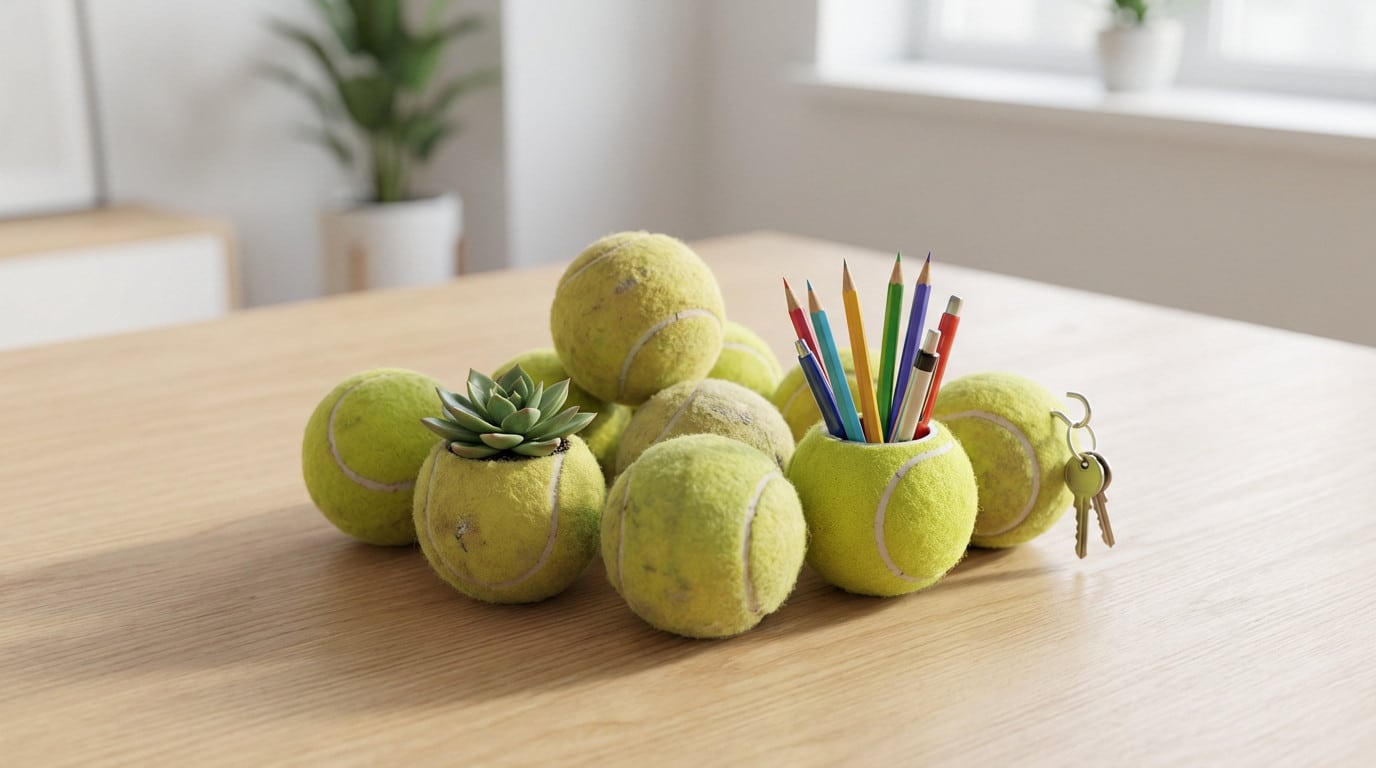
- Hide valuables: A slit in a ball creates a discreet container for cash, keys, or jewelry.
- Organize cables: Cut two slits to create a simple holder that keeps cords from tangling.
- Hold gift cards: Decorate a ball with a slit to make a fun and original gift card holder.
Health and Mobility Aids
Physical relief doesn’t always require a therapist. These rubber spheres work wonders for muscle tension and mobility support right at home.
- DIY massage tool: Put two balls in a sock and roll it over tense back or shoulder muscles.
- Relieve lower back pain: Roll a ball under your foot from heel to toe to stretch your calf and hamstring, which can ease back tension.
- Stabilize walkers and protect floors: Cut an ‘X’ and place them on walker legs for smoother gliding or on chair legs to protect hardwood floors.
A Quick-Glance Guide To Upcycling Your Tennis Balls
With so many ideas floating around, it helps to have a bird’s-eye view. Here is a summary to help you pick the best second life for your worn-out gear.
Your Upcycling Cheat Sheet
We designed this breakdown for instant clarity. It maps out all 11 solutions at a glance. You can match the method to your specific need. We also flagged the effort level for every single trick.
| Reuse Method | Category | Effort Level |
|---|---|---|
| Stabilize walkers / Protect floors | Mobility & Home Care | Easy (requires cutting) |
| Open jars | Kitchen Hack | Very Easy (requires cutting) |
| Accelerate clothes drying | Laundry & Energy Saving | Very Easy |
| Make toilets more efficient | Home & Water Saving | Very Easy |
| DIY massage tool | Health & Wellness | Easy (requires a sock) |
| Relieve lower back pain | Health & Wellness | Very Easy |
| Hide valuables | Security & Storage | Easy (requires cutting) |
| Hold gift cards | Gifting & Crafts | Easy (requires cutting) |
| Perfect garage parking | Garage & Safety | Medium (requires hanging) |
| Organize cables | Organization | Easy (requires cutting) |
| Clean your pool | Pool Maintenance | Very Easy |
The Bigger Picture: Organized Recycling and Upcycling
While DIY hacks are excellent for a few items, what happens when you have dozens or hundreds to manage? This is where large-scale recycling programs come into play.
How Large-Scale Programs Are Changing the Game
Specialized organizations are finally tackling this issue on an industrial scale. You need to know about RecycleBalls and Rebounces, as they are the undeniable main players driving used tennis balls recycling forward today.
Their mission is straightforward: they actively collect millions of used balls across the United States every year to prevent them from ending up in our landfills.
These initiatives transform a problematic waste product into a valuable resource.
From Used Ball to Valuable Resource
The engineering here is smart. RecycleBalls utilizes a specialized machine called PLAY IT GREEN that separates the felt from the rubber. The resulting ground rubber is appropriately called “GREEN GOLD”.
This “GREEN GOLD” has concrete applications. It is used to create high-performance coatings for tennis courts, footing for equestrian arenas, and safe surfaces for playgrounds.
Even the felt gets reused, often finding a second life as insulation or in other industrial applications.
How You Can Participate
Participating is straightforward. Clubs and individuals can easily sign up on these organizations’ websites to receive collection boxes and prepaid shipping labels to send back their old balls.
Participation might involve shipping fees, but it is a small price to pay for the positive environmental impact. I suggest asking your local tennis club if they are already involved.
Whether repurposing old balls for household hacks or contributing to industrial recycling initiatives, we hold the power to mitigate this silent environmental toll. By viewing used tennis balls as valuable resources rather than disposable waste, we ensure the sport remains green. Let us champion sustainability, one serve at a time.