Guessing your vehicle’s limits invites mechanical failure and endangers everyone on the road. We clarify the exact mitsubishi towing capacity for each model to ensure you haul your equipment with absolute confidence. You will discover the precise torque figures and engineering specifications that dictate real performance.
Mitsubishi Towing Capacity: The Numbers You Need
The Popular SUVs: Outlander and Eclipse Cross
Specs shift by trim. Let’s look at the mitsubishi towing capacity for the rigs you actually drive.
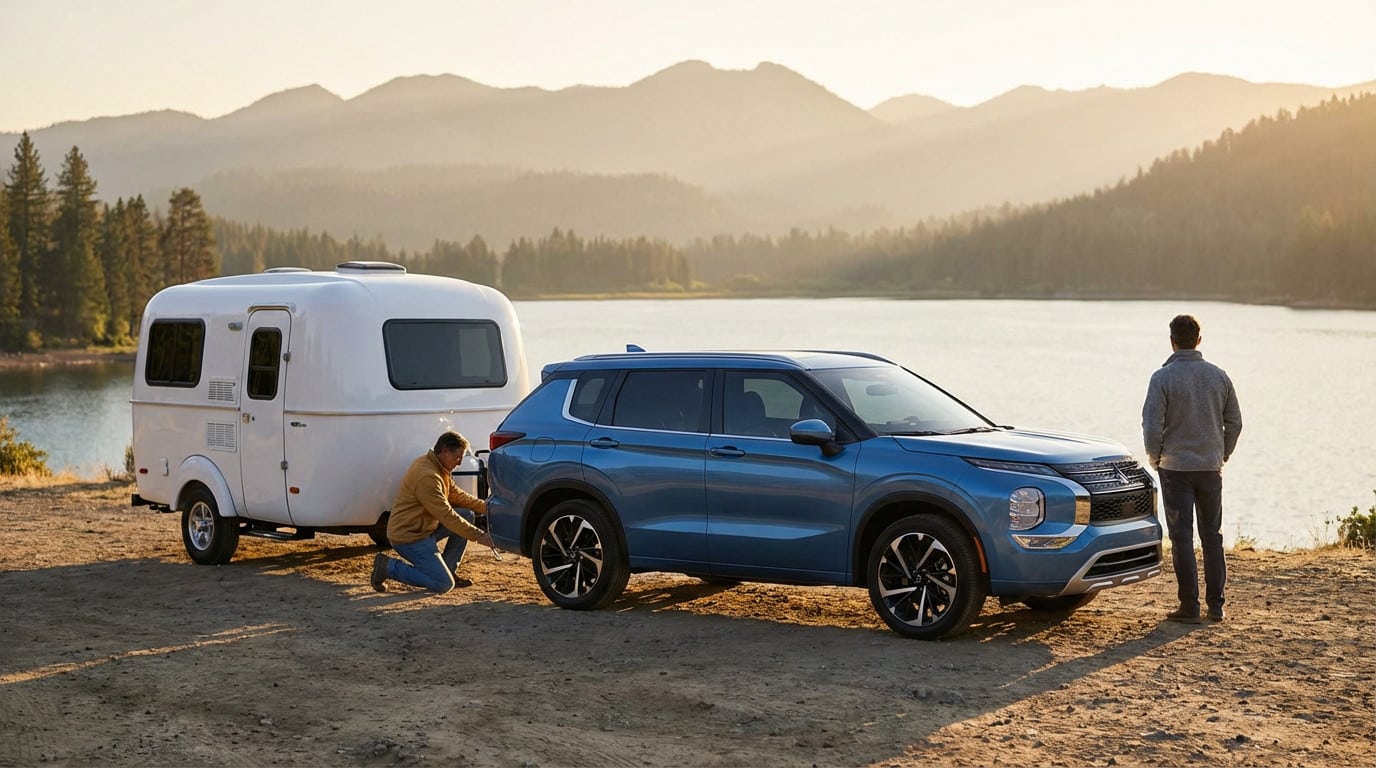
The gas Outlander pulls 2,000 lbs; the PHEV handles 1,500 lbs. That’s enough grunt for jet skis or a weekend camper.
The Mitsubishi Eclipse Cross sits between 1,500 and 1,600 lbs. It handles light utility trailers without breaking a sweat.
| Model | Maximum Towing Capacity (lbs) | Engine/Configuration | Typical Load Example |
|---|---|---|---|
| Mitsubishi Outlander (current gen) | 2,000 lbs | 2.5L 4-Cylinder | Small utility trailer |
| Mitsubishi Outlander PHEV (2023+) | 1,500 lbs | 2.4L Hybrid + Electric Motors | Jet-ski trailer |
| Mitsubishi Outlander (older V6) | 3,500 lbs | V6 Engine (discontinued) | Small travel trailer |
| Mitsubishi Eclipse Cross | 1,500 – 1,600 lbs | Turbocharged 4-Cylinder | ATV trailer |
| Mitsubishi Outlander Sport | ~1,500 lbs (Not officially rated) | 2.0L/2.4L 4-Cylinder | Lightweight utility trailer |
| Mitsubishi Mirage G4 | ~1,000 lbs | 1.2L 3-Cylinder | Smallest utility carts |
The Outlander Sport and Mirage: A Word of Caution
Don’t confuse the Outlander with the Outlander Sport. In many markets, the Sport isn’t officially rated for towing due to its CVT.
Some sources suggest 1,500 lbs, but verify your manual. Towing with a vehicle not built for it destroys transmissions.
The Mitsubishi Mirage G4 offers about 1,000 lbs. According to recent data, this limits you to very light carts; pushing it invites trouble.
What Really Determines Towing Power
Now that the numbers are laid out, we need to look at what is actually happening under the hood. Towing capacity is not some magic figure; it is the direct result of the vehicle’s engineering.
It’s All About Torque, Not Just Horsepower
Most drivers obsess over horsepower figures. That is a mistake. For heavy hauling, torque is more important than raw horsepower. It is the torque—that twisting force—that gets mass moving, not just how fast the engine spins.
Look at diesel engines. They are towing favorites because they dump massive torque at very low RPMs. That initial brute force makes all the difference when pulling away from a stop.
Mitsubishi engineers understand this balance well. They aim for efficiency without sacrificing the grunt needed for mitsubishi towing capacity. The Outlander PHEV, for instance, pushes a solid 335 lb-ft of torque.
The Unsung Heroes: Frame, Suspension, and Cooling
A massive engine means nothing without a skeleton to hold it. The vehicle’s structural design is absolutely fundamental.
Think about suspension and wheelbase. A longer wheelbase keeps you pointing straight. Meanwhile, a stiff suspension stops the rear end from sagging. It handles the trailer’s heavy tongue weight.
Then there is the heat factor. Towing cooks your engine and transmission. That is why factory tow packages include upgraded coolers. They stop you from frying your expensive components on a steep hill.
- Engine Torque: The primary force for pulling heavy loads.
- Transmission and Axle Ratio: How power is delivered to the wheels.
- Structural Design: The strength of the vehicle’s frame and chassis.
- Suspension System: Manages the load and maintains stability.
- Braking System: Essential for stopping the combined weight safely.
- Cooling Systems: Prevents overheating of the engine and transmission.
Towing Safely: The Non-Negotiable Rules
Knowing the mechanics is good. But turning it into safe practice on the road is what really counts. Ignoring these rules simply isn’t an option.
Before You Even Start the Engine
First, you must know the specific towing capacity of your vehicle. This isn’t a suggestion; it is a hard limit defined by the manufacturer to keep you and your passengers safe.
Next, look at your gear. Using a high-quality hitch and wiring harness that matches your load is non-negotiable. If you are thoroughly inspecting a used vehicle, check these components first, as weak gear causes catastrophes.
Finally, master weight distribution. You need 60% of the weight in front of the trailer axles and 40% behind. Get this wrong, and you invite dangerous trailer sway.
On the Road: New Rules for Driving
Once you move, everything changes. With a trailer, your braking distances are considerably increased. You must leave significantly more space between you and the car ahead, because anticipation is the key to survival.
Watch your speed. Drive slower than usual, especially on winding turns or steep descents. Every maneuver—whether accelerating, braking, or turning—must be smooth and progressive to maintain control.
Consider the “80% rule.” For a real safety buffer, many experts suggest you never load the trailer beyond 80% of your mitsubishi towing capacity. It saves your transmission.
- Know your vehicle’s towing capacity: Check the owner’s manual. Never exceed it.
- Use quality, compatible equipment: Your hitch and wiring must match the load.
- Distribute weight correctly: Aim for a 10-15% 10-15% tongue weight and a 60/40 front/rear cargo balance.
- Check tires and brakes: Before every single trip, inspect tire pressure (on both vehicle and trailer) and test brake lights.
- Adapt your driving style: Drive slower, increase following distance, and avoid sudden maneuvers.
Understanding the Jargon: GVWR, Payload, and Tongue Weight
To master Mitsubishi towing capacity, you must speak the engineer’s language. These acronyms separate safe towing from dangerous guessing.
More Than Just the Trailer’s Weight
GVWR represents the absolute max weight your vehicle can handle, including passengers and cargo. Since the trailer adds load, exceeding this figure invites mechanical failure.
Payload is simply what the cabin and bed can transport. Don’t forget that tongue weight eats into this limit; you must subtract that hitch pressure from your available capacity.
Tongue Weight is the downward force on the hitch. For stability, this must be 10 to 15% of the total trailer weight to avoid dangerous swaying.
- GVWR: Max vehicle weight with passengers, cargo, and tongue weight.
- Payload: Max weight carried in the cabin and bed.
- Tongue Weight: The downward force applied to the hitch.
- GCWR: Max combined weight of vehicle and trailer, critical when towing heavy loads.
Mastering your Mitsubishi’s towing capabilities transforms a simple drive into a confident adventure. By respecting the engineering limits of models like the Outlander and adhering to safety protocols, we ensure every journey remains secure. We invite you to consult your manual, hitch up responsibly, and explore the open road with the assurance that preparation provides.